Advertisements
Advertisements
Question
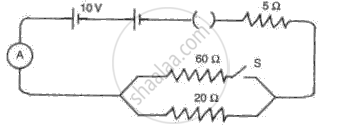
In the circuit shown in fig. 6, find the reading of the ammeter A when the switch S is
(a) Opened.
(b) Closed.
Advertisements
Solution
(a) When the switch S is opened, resistance 60Ω is not connected in the circuit and current flows through the 20Ω resistor.
:. Resistance of the circuit. when the switch is open:
R= 20 + 5 = 25 Ω
Given, voltage = 10 V
:. current through the circuit, I= `"V"/"R" = 10/25` = 0.4 A
The reading of the ammeter is thus 0 .4 A, when the switch is open.
(b) When the switch is closed, resistance 60 Ω gets connected to the circuit.
Thus, in the circuit the parallel combination of 60 Ω and 200 resistors is connected in series with the 5 Ω resistor.
:. Resistance in parallel, `1/"R"_"P" = 1/60 + 1/20 = (1 + 3)/60 = 4/60` Ω
or `"R"_"P" = 15 Ω
Now, total resistance of the circuit= 15 + 5 = 20 Ω
current through the circuit, I= `"V"/"R" = 10/20 = 0.5 "A"`
The reading of the ammeter is thus 0 .5 A, when the switch is closed.
APPEARS IN
RELATED QUESTIONS
Which particles constitute the electric current in a metallic conductor?
Three resistors are connected as shown in the diagram.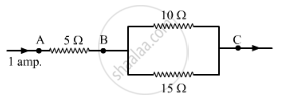
Through the resistor 5 ohm, a current of 1 ampere is flowing.
(i) What is the current through the other two resistors?
(ii) What is the p.d. across AB and across AC?
(iii) What is the total resistance
Ten bulbs are connected in a series circuit to a power supply line. Ten identical bulbs are connected in a parallel circuit to an identical power supply line.
(c) In which circuit, if one bulb blows out, all other will stop glowing?
Which is the better way to connect lights and other electrical appliances in domestic wiring: series circuits or parallel circuits? why?
A fuse is a short piece of wire of high ______ and low ______.
A bulb marked 12 V, 24 W operates on a 12 volt car battery for 20 minutes. Calculate:
(i) The current flowing through it, and
(ii) The energy liberated.
60 joules of heat was dissipated in a resistor when 20 C flowed for 5 s. Calculate:
(a) P.d. across the resistor,
(b) Resistance of the resistor, and
(c) Average power dissipated in the resistor.
What is the function of a step-up transformer?
Water : pipe :: Electric current : ______.
