Advertisements
Advertisements
Question
Three resistors are connected as shown in the diagram.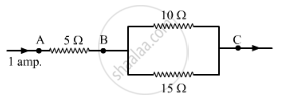
Through the resistor 5 ohm, a current of 1 ampere is flowing.
(i) What is the current through the other two resistors?
(ii) What is the p.d. across AB and across AC?
(iii) What is the total resistance
Advertisements
Solution
The resistance between B and C are in parallel. Hence the total resistance, R between B and C is given by:
RBC= [15 x 10 ] / [ 15 + 10 ] = 6 Ω ... (a)
Potential drop across B and C = IR = 1 x 6 = 6 V
Current through the 10 Ω resistor = V / R = 6 / 10 = 0.6 A
Current through the 15 Ω resistor = V / R = 6 / 15 = 0.4 A
p.d. across AB:
VAB = 5 x 1 = 5 V
p.d. across AC:
VAC = I x RAC
RAC = R + 5 = 11 Ω (see equation (a) )
VAC = 1 x 11 = 11 V
Total resistance, RAC = RBC + RAC
= 6 + 5
= 11 Î
APPEARS IN
RELATED QUESTIONS
Which of the following units could be used to measure electric charge?
(a) ampere
(b) joule
(c) volt
(d) coulomb
How many milliamperes as there in 1 ampere?
Compare how an ammeter and a voltmeter are connected in a circuit.
A Radio Set Draws a Current of 0.36 a for 15 Minutes. Calculate the Amount of Electric Charge that Flows Through the Circuit.
If the charge on an electron is 1.6 × 10⁻¹⁹ coulombs, how many electrons should pass through a conductor in 1 second to constitute 1 ampere current?
How many electrons are flowing per second past a point in a circuit in which there is a current of 5 amp?
Name two devices which work on the heating effect of electric current.
In the network shown in the following adjacent Figure, calculate the equivalent resistance between the points.
- A and B
- A and C

Two resistors of 2.0 Ω and 3.0 Ω are connected (a) in series (b) in parallel, with a battery of 6.0 V and negligible internal resistance. For each case draw a circuit diagram and calculate the current through the battery.
The work done in moving unit positive charge across two points in an electric circuit is a measure of
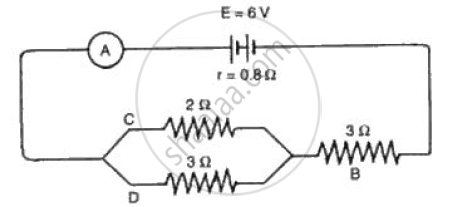
The circuit diagram (Fig.) shows a battery of e.m.f. 6 volts and internal
resistance of 0.8 Ω oonnected in series. Find the
(a) Current reoorded by the ammeter,
(b) P.d. across the terminals of the resistor B,
( c) Current passing through each of the resistors B, C and D, and
( d) P.d. across the terminals of the battery.
An auto lamp is joined to a battery of e.m.f. 4 V and internal resistance 2.5Ω. A steady current of 0.5 A flows through the circuit. Calculate the
(a) Total energy provided by battery in 10 minutes,
(b) Heat dissipated in the bulb in 10 minutes.
A 3 pin mains plug is fitted to the lead for a 1 kW electric kettle to be used on a 250 V A.C. supply. Which of the following statements is NOT correct?
(a) A 13 A fuse is the most appropriate value to use.
(b) The brown wire should be connected to the live side of the mains.
Three heaters each rated 250 W, 100 V are connected in parallel to a 100 V supply. Calculate :
The total current taken from the supply
Three resistances, of which two are equal when connected in series have an effective resistance of 30 ohms. When the three resistances are connected in parallel, the effective resistances is 3 ohms. Find the values of the individual resistances.
An ammeter is always placed in parallel with the circuit.
