Advertisements
Advertisements
Question
If the charge on an electron is 1.6 × 10⁻¹⁹ coulombs, how many electrons should pass through a conductor in 1 second to constitute 1 ampere current?
Advertisements
Solution
Given:
Current,/=1A
Time,t=1s
Using the formula:
`I=Q/t`
or,
`Q=Ixxt `
=`1xx1`
=1=C
Now, if the charge is `1.6xx10^-19`C, the number of electrons is 1.So, if the charge is 1C, the number of electrons is given by:
`1/(1.6xx10^-19)xx1=6.25xx10^18`
Thus, `6.25xx10^18`electrons should pass though a conductor in 1 second to constitute 1 ampere current.
APPEARS IN
RELATED QUESTIONS
Why are metals good conductors of electricity whereas glass is a bad conductor of electricity? Give reason?
Fill in the blank:
To increase the effective resistance in a circuit the resistors are connected in _____________.
Draw the electrical symbols of the following components and state its use:
Rheostat (variable resistance)
What is the Flow of Charge Called?
One coulomb of charge flows through any cross-section of a conductor in 1 second. What is the current flowing through the conductor?
Which instrument is used to measure electric current? How should it be connected in a circuit?
In which of the following cases more electrical energy is consumed per hour?
(i) A current of 1 ampere passed through a resistance of 300 ohms.
(ii) A current of 2 amperes passed through a resistance of 100 ohms.
State the relation between work, charge and potential difference for an electric circuit.
Two resistors P and Q of the same material and length but of different thickness are connected in parallel to a battery. The cross- sectional area of P is twice that of Q. What is the ratio of
(a) The resistance of P to the resistance of Q?
(b) The current in P to the current in Q?
Find the effective resistance in the following circuit diagrams (Fig.):
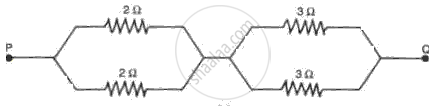
What is the criteria for selecting a fuse wire?
60 joules of heat was dissipated in a resistor when 20 C flowed for 5 s. Calculate:
(a) P.d. across the resistor,
(b) Resistance of the resistor, and
(c) Average power dissipated in the resistor.
A bulb marked 12 V, 24 W operates on a 12 V battery for 20 minutes. Calculate:
- The current flowing through it, and
- The energy consumed.
An electric bulb is rated 250 W, 230 V.
- the energy consumed in one hour, and
- the time in which the bulb will consume 1.0 kWh energy when connected to 230 V mains.
An electrical gadget can give an electric shock to its user under certain circumstances. Mention any two of these circumstances.
- What is meant by electric current?
- Name and define its unit.
- Which instrument is used to measure the electric current? How should it be connected in a circuit?
Match the following:
| 1. | 1 mA | a. | series |
| 2. | 1 pA | b. | ohmmeter |
| 3. | Ammeter | c. | 10-6 ampere |
| 4. | Electrical resistivity | d. | 10-3 ampere |
