Advertisements
Advertisements
Question
A current of 1 A is drawn by a filament of an electric bulb. Number of electrons passing through a cross section of the filament in 16 seconds would be roughly
Options
1020
1016
1018
1023
Advertisements
Solution
1020
Explanation -
Current, i = 1A
Time, t = 16s
`"i" = "q"/"t"`
`"q" = "i" xx "t"`
q = 1 × 16
q = 16 C
Now,
q = n × e
where, n is number of electrons lost or gained
e = charge on 1 electron (1.6 × 10⁻¹⁹ C)
`"n" = "q"/"e"`
`n = 16/(1.6 xx 10^(-19))`
n = 1020
APPEARS IN
RELATED QUESTIONS
If 20 C of charge pass a point in a circuit in 1 s, what current is flowing?
Which unit could be used to measure current?
(a) Watt
(b) Coulomb
(c) Volt
(d) Ampere
An electric circuit consisting of a 0.5 m long nichrome wire XY, an ammeter, a voltmeter, four cells of 1.5 V each and a plug key was set up.
Following graph was plotted between V and I values:
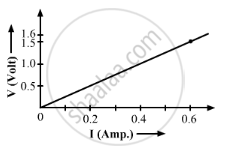
What would be the values of `V/I` rations when the potential difference is 0.8 V, 1.2 V and 1.6 V respectively?
What conclusion do you draw from these values?
What is the resistance of the wire?
Ten bulbs are connected in a series circuit to a power supply line. Ten identical bulbs are connected in a parallel circuit to an identical power supply line.
(c) In which circuit, if one bulb blows out, all other will stop glowing?
Which is the better way to connect lights and other electrical appliances in domestic wiring: series circuits or parallel circuits? why?
Draw a circuit diagram showing two electric lamps connected in parallel together with a cell and a switch that works both lamps. Mark an â’¶ on your diagram to show where an ammeter should be placed to measure the current.
A fuse is a short piece of wire of high ______ and low ______.
The diagram shows two ways of connecting three lamps P, Q and R to A.C. supply of 220 V.
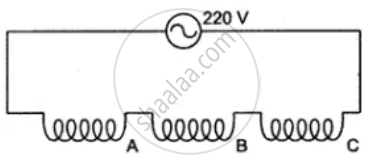
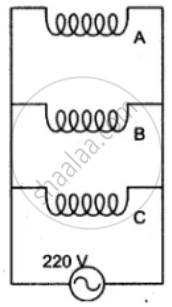
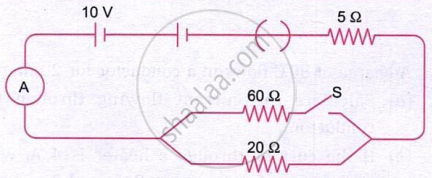
In the circuit shown in fig., find the reading of the ammeter A when the switch S is opened.
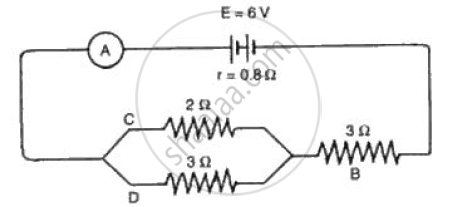
The circuit diagram (Fig.) shows a battery of e.m.f. 6 volts and internal
resistance of 0.8 Ω oonnected in series. Find the
(a) Current reoorded by the ammeter,
(b) P.d. across the terminals of the resistor B,
( c) Current passing through each of the resistors B, C and D, and
( d) P.d. across the terminals of the battery.
What is the function of a step-up transformer?
A current of 0.2 A flows through a wire whose ends are at a potential difference of 15 V. Calculate:
(i) The resistance of the wire, and
(ii) The heat energy produced in 1 minute.
Three resistances, of which two are equal when connected in series have an effective resistance of 30 ohms. When the three resistances are connected in parallel, the effective resistances is 3 ohms. Find the values of the individual resistances.
State whether true or false. If false, correct the statement.
Current can produce magnetic field.
Problems for practice:
If 3A current flows through a circuit, then convert the current in terms of a milliampere.
The RMS value of AC is defined as:
Electric current flows through a circuit only when:
What happens when the switch in a circuit is turned OFF (open circuit)?
