Advertisements
Advertisements
प्रश्न
A current of 1 A is drawn by a filament of an electric bulb. Number of electrons passing through a cross section of the filament in 16 seconds would be roughly
विकल्प
1020
1016
1018
1023
Advertisements
उत्तर
1020
Explanation -
Current, i = 1A
Time, t = 16s
`"i" = "q"/"t"`
`"q" = "i" xx "t"`
q = 1 × 16
q = 16 C
Now,
q = n × e
where, n is number of electrons lost or gained
e = charge on 1 electron (1.6 × 10⁻¹⁹ C)
`"n" = "q"/"e"`
`n = 16/(1.6 xx 10^(-19))`
n = 1020
संबंधित प्रश्न
Fill in the blank:
To increase the effective resistance in a circuit the resistors are connected in _____________.
If the charge on an electron is 1.6 × 10⁻¹⁹ coulombs, how many electrons should pass through a conductor in 1 second to constitute 1 ampere current?
One coulomb of charge flows through any cross-section of a conductor in 1 second. What is the current flowing through the conductor?
What is the conventional direction of the flow of electric current? How does it differ from the direction of flow electrons?
What happens to the other bulbs in a parallel circuit if one bulb blows off?
Consider the circuit given below:
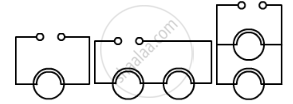
(a) In which circuit are the lamps dimmest?
(b) In which circuit or circuits are the lamps of equal brightness to the lamps in circuit (i)?
(c) Which circuit gives out the maximum light?
Consider the circuit given below when A, B and C are three identical light bulbs of constant resistance. 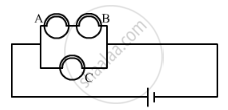
(a) List the bulbs in order of increasing brightness.
(b) If C burns out, what will be the brightness of A now compared with before?
(c) If B burns out instead, what will be the brightness of A and C compared with before?
If the current passing through a conductor is doubled, what will be the change in heat produced
Which effect of current is utilised in the working of an electric fuse?
A bulb marked 12 V, 24 W operates on a 12 volt car battery for 20 minutes. Calculate:
(i) The current flowing through it, and
(ii) The energy liberated.
Find the effective resistance in the following circuit diagrams (Fig.):
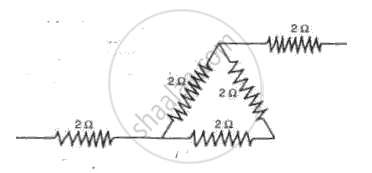
Fig . shows the core of a transformer and i ts input and output connections
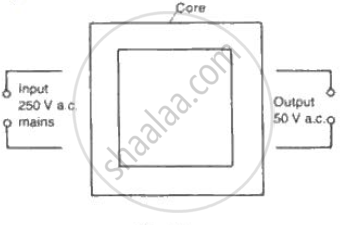
State the material used for the core and describe th e structure of the core.
(a) Use the values given in the diagram to calculate the turns ratio for the transformer and connections, labeling all parts of the diagram .
(b) If a current of 2 A is taken from th e output, calculate th e current in the input circuit (Assume the transformer to be ideal ).
A bulb of 40 W is used for 12.5 h each day for 30 days. Calculate the electrical energy consumed.
An electric bulb is rated 250 W, 230 V.
- the energy consumed in one hour, and
- the time in which the bulb will consume 1.0 kWh energy when connected to 230 V mains.
Three heaters each rated 250 W, 100 V are connected in parallel to a 100 V supply of the energy supplied in kWh to the three heaters in 5 hours.
A bulb is connected to a battery of p.d. 4 V and internal resistance 2.5 Ω . A steady current of 0.5 A flows through the circuit. Calculate:
The total energy supplied by the battery in 10 minutes
How is direction of current related to the direction of flow of electrons?
Which part of an electrical appliance is earthed?
An electrical appliance is rated at 1000 KVA, 220V. If the appliance is operated for 2 hours, calculate the energy consumed by the appliance in: (i) kWh (ii) joule.
A current of 2A passing through the conductor produces 80 J of heat in 10 seconds. The resistance of the conductor is ______.
The electron was discovered in 1897 by:
