Advertisements
Advertisements
Question
Match the pairs.
| ‘A’ Group | ‘B’ Group |
| 1. Free electrons | a. V/R |
| 2. Current | b. Increases the resistance in the circuit |
| 3. Resistivity | c. Weakly attached |
| 4. Resistances in series | d. VA/LI |
Advertisements
Solution
| ‘A’ Group | Answer |
| 1. Free electrons | c. Weakly attached |
| 2. Current | a. V/R |
| 3. Resistivity | d. VA/LI |
| 4. Resistances in series | b. Increases the resistance in the circuit |
APPEARS IN
RELATED QUESTIONS
In the circuit diagram given below, three resistors R1, R2, and R3 of 5 Ω, 10 Ω and 30 Ω, respectively are connected as shown
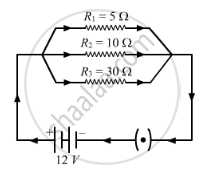
Calculate:
- current through each resistor.
- total current in the circuit.
- total resistance in the circuit.
State the S.I. unit of current.
Calculate the amount of energy transferred by a 10 A electric current flowing through a resistor of 5 o for 15 minutes.
Tick(✓) the correct choice in the following:
24 watt, 12 volt head lamp is fully lit by connecting it to a 12 volt
battery. The working resistance of the lamp is
Two resistors P and Q of the same material and length but of different thickness are connected in parallel to a battery. The cross- sectional area of P is twice that of Q. What is the ratio of
(a) The resistance of P to the resistance of Q?
(b) The current in P to the current in Q?
In a house there are 6 bulbs of 100 W each used for 4 hours a day, 4 bulbs of 60 W each used for 8 hours a day, an immersion heater of 2.5 kW used for 1 hour per day, and an electric iron of 800 W used for 2 hours per day. Calculate the cost of monthly electric bill for the month of April at the rate of 80 p per unit.
If the potential differences between two parts of a thundercloud is 10s V,
what is the amount of energy given up during the passage of 20 coulombs?
(a)2x10⁻⁷J
(b)200J
(c)Sx106 j
(d)2x 10⁹J
(e)2x 10¹⁰ J
A bulb is connected to a battery of p.d. 4 V and internal resistance 2.5 Ω . A steady current of 0.5 A flows through the circuit. Calculate:
The energy dissipated in the bulb in 10 minutes.
What determines the direction of flow of electrons between two charged conductors kept in contact?
Conventionally, the direction of the current is taken as:
What is the rate at which charges flow past a point on a circuit?
Electric current is defined as:
A continuous and closed path of an electric current is called:
By convention, the direction of electric current in the external circuit is taken as:
The relationship between conventional current and electron flow is that they are:
The number of electrons required to produce a total charge of 1.6 C is:
In the process of current flow through a conductor, the amount of charge passing per unit time gives:
