Advertisements
Advertisements
Question
Advertisements
Solution
'An electric bulb is rated 250 W-230V'; means that if the bulb is lighted on a 230V supply it consumes 25 ow electrical power or 25 OJ of electrical energy converts into heat and light in 1 second.
The safe Ii m it of current through the bulb is:
I = `"P"/"V" = 250/230` = 1.1 A
Current through a 60W lamp rated for 250V is:
I = `"P"/"V" = 60/250` = 0.24 A
We know that resistance of an appliance remains constant.
Resistance of the 1 amp =
R = `"P"/"I"^2 = 60/(0.24)^2 Omega`
If the line voltage falls to 200 V, power =
P = `"V"^2/"R" = (200 xx 200 xx (0.24)^2)/60` = 38.4 watt
Thus power of the lamp reduces to 38. 4 watt.
APPEARS IN
RELATED QUESTIONS
Christmas tree lamps are usually wired in series. What happens if one lamps breaks?
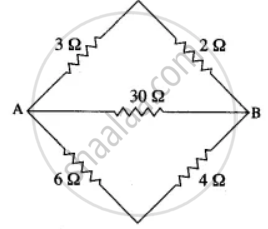
Calculate the equivalent resistance between A and B in the adjacent diagram.
An auto lamp is joined to a battery of e.m.f. 4 V and internal resistance 2.5Ω. A steady current of 0.5 A flows through the circuit. Calculate the
(a) Total energy provided by battery in 10 minutes,
(b) Heat dissipated in the bulb in 10 minutes.
Three heaters each rated 250 W, 100 V are connected in parallel to a 100 V supply. Calculate :
The total current taken from the supply
A bulb is connected to a battery of p.d. 4 V and internal resistance 2.5 Ω . A steady current of 0.5 A flows through the circuit. Calculate:
The energy dissipated in the bulb in 10 minutes.
State expression for Cells connected in series.
State the conditions for the flow of charge in a circuit from one point to the other.
Which of the following is the example expression for Alternating Current?
The number of electrons required to produce a total charge of 1.6 C is:
