Advertisements
Advertisements
Question
Two resistors of 4 Ω and 6 Ω are connected in parallel. The combination is
connected across a 6 volt battery of negligible resistance. Calculate:
( i) The power supplied by the battery,
(ii) The power dissipated in each resistor.
Advertisements
Solution
Total resistance of resitors of 4 Ω and 6 Ω in parallel is:
RP = `[1/4 + 1/6]^-1 = 2.4 Omega`
Given voltage supply= 6 volt
(i) Power supplied by the battery, P = `"V"^2/"R" = (6 xx 6)/2.4` = 15 watt
(ii) Power dissipated in 4 Ω resistor, P1 = `"V"^2/"R" = (6 xx 6)/4` = 9 watt
Power dissipated in 6 Ω resistor, P1 `"V"^2/"R" = (6 xx 6)/6` = 6 watt
APPEARS IN
RELATED QUESTIONS
Consider the circuit given below:
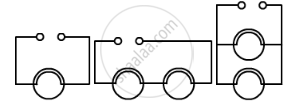
(a) In which circuit are the lamps dimmest?
(b) In which circuit or circuits are the lamps of equal brightness to the lamps in circuit (i)?
(c) Which circuit gives out the maximum light?
A bulb marked 12 V, 24 W operates on a 12 V battery for 20 minutes. Calculate:
- The current flowing through it, and
- The energy consumed.
State whether true or false. If false, correct the statement.
Current can produce magnetic field.
- What is meant by electric current?
- Name and define its unit.
- Which instrument is used to measure the electric current? How should it be connected in a circuit?
What are the effects of electric current?
The number of electrons constituting a 1-coulomb charge is ______.
Find the odd one out.
Loudspeaker, Bar magnet/magnet, Electric motor, Microphone.
By convention, the direction of electric current in the external circuit is taken as:
