Advertisements
Advertisements
प्रश्न
Two resistors of 4 Ω and 6 Ω are connected in parallel. The combination is
connected across a 6 volt battery of negligible resistance. Calculate:
( i) The power supplied by the battery,
(ii) The power dissipated in each resistor.
Advertisements
उत्तर
Total resistance of resitors of 4 Ω and 6 Ω in parallel is:
RP = `[1/4 + 1/6]^-1 = 2.4 Omega`
Given voltage supply= 6 volt
(i) Power supplied by the battery, P = `"V"^2/"R" = (6 xx 6)/2.4` = 15 watt
(ii) Power dissipated in 4 Ω resistor, P1 = `"V"^2/"R" = (6 xx 6)/4` = 9 watt
Power dissipated in 6 Ω resistor, P1 `"V"^2/"R" = (6 xx 6)/6` = 6 watt
APPEARS IN
संबंधित प्रश्न
Three 2 V cells are connected in series and used as a battery in a circuit.
- What is the p.d. at the terminals of the battery?
- How many joules of electrical energy does 1 C gain on passing through
- one cell
- all three cells?
Fill in the folloing blank with suitable words:
Current is measured in ............... using an ............... placed in ............... in a circuit.
What is an Ammeter? How is It Connected in a Circuit? Draw a Diagram to Illustrate Your Answer.
Ten bulbs are connected in a series circuit to a power supply line. Ten identical bulbs are connected in a parallel circuit to an identical power supply line.
- Which circuit would have the highest voltage across each bulb?
- In which circuit would the bulbs be brighter?
- In which circuit, if one bulb blows out, all others will stop glowing?
- Which circuit would have less current in it?
Draw a circuit diagram showing two lamps, one cell and a switch connected in series.
How can you change the brightness of the lamp?
A fuse is a short piece of wire of high ______ and low ______.
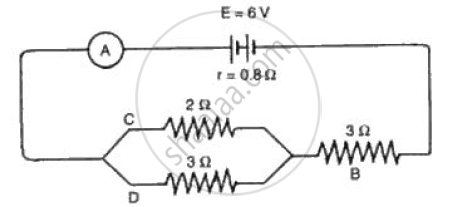
The circuit diagram (Fig.) shows a battery of e.m.f. 6 volts and internal
resistance of 0.8 Ω oonnected in series. Find the
(a) Current reoorded by the ammeter,
(b) P.d. across the terminals of the resistor B,
( c) Current passing through each of the resistors B, C and D, and
( d) P.d. across the terminals of the battery.
An electric bulb is rated '100 W, 250 V'. How much current will the bulb draw if connected to a 250 V supply?
The RMS value of AC is defined as:
