Advertisements
Advertisements
प्रश्न
Two resistors of 4 Ω and 6 Ω are connected in parallel. The combination is
connected across a 6 volt battery of negligible resistance. Calculate:
( i) The power supplied by the battery,
(ii) The power dissipated in each resistor.
Advertisements
उत्तर
Total resistance of resitors of 4 Ω and 6 Ω in parallel is:
RP = `[1/4 + 1/6]^-1 = 2.4 Omega`
Given voltage supply= 6 volt
(i) Power supplied by the battery, P = `"V"^2/"R" = (6 xx 6)/2.4` = 15 watt
(ii) Power dissipated in 4 Ω resistor, P1 = `"V"^2/"R" = (6 xx 6)/4` = 9 watt
Power dissipated in 6 Ω resistor, P1 `"V"^2/"R" = (6 xx 6)/6` = 6 watt
APPEARS IN
संबंधित प्रश्न
Which of the two is connected in series : ammeter or voltmeter?
Write down the formula which relates electric charge, time and electric current
The circuit diagram given below shows the combination of three resistors R1, R2 and R3:
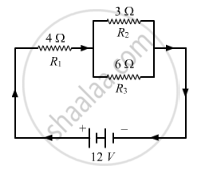
Find :
(i) total resistance of the circuit.
(ii) total current flowing in the circuit.
(iii) the potential difference across R1.
In the circuit shown below, the voltmeter reads 10 V.
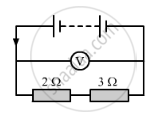
(a) What is the combined resistance?
(b) What current flows?
(c) What is the p.d. across 2 Ω resistor?
(d) What is the p.d. across 3 Ω resistor?
If you were going to connect two light bulbs to one battery, would you use a series or a parallel arrangement? Why? Which arrangement takes more current from the battery?
The circuit diagram in fig shows two coils of an insulated copper wire wound on a cardboard tube. G is a center zero galvanometer.
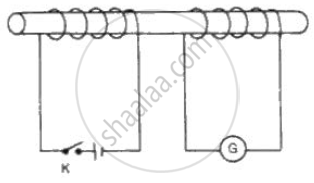
(a) Describe what will happen when th e swi tch K is cl osed for severa l
seconds and then opened again .
(b) What will be the effect of repeating the experiment with an iron placed in the tube?
An electrical gadget can give an electric shock to its user under certain circumstances. Mention any two of these circumstances.
The flow of electric charge per unit time is called potential difference.
