Advertisements
Advertisements
Question
Advertisements
Solution
The fuse helps to control the maximum current in an electrical circuit. The fuse protects an electrical circuit by melting and breaking the circuit, whenever the current exceeds the pre-determined limit in the circuit. Due to low melting point, the fuse wire melts and then breaks the circuit.
APPEARS IN
RELATED QUESTIONS
In 10 s, charge of 25 C leaves a battery, and 200 J of energy are delivered to an outside circuit a result.
What current flows from the battery?
In the circuit diagram given below five resistances of 10 Ω, 40 Ω, 30 Ω, 20 Ω, and 60 Ω are connected as shown to a 12 V battery.
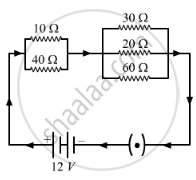
Calculate:
(a) total resistance in the circuit.
(b) total current flowing in the circuit.
What happens to the other bulbs in a series circuit if one bulb blows off?
In the network shown in the following adjacent Figure, calculate the equivalent resistance between the points.
- A and B
- A and C

What would be the danger involved in replacing a blown fuse with the one which would carry a large current?
Three heaters each rated 250 W, 100 V are connected in parallel to a 100 V supply. Calculate :
The total current taken from the supply
Unit of electric power may also be expressed as
Which of the following is the example expression for Alternating Current?
A charge of 20 C flows through a conductor in 4 s. The electric current through the conductor is:
