Advertisements
Advertisements
Question
For a heater rated at 4 kW and 220 V, calculate:
(a) the current,
(b) the resistance of the heater,
(c) the energy consumed in 2 hours, and
(d) the cost if 1 kWh is priced at Rs 4.60.
Advertisements
Solution
Given:
V=220V
`P=4KW=4xx10^3W`
(a) `I=P/V=(4xx10^3)/220=18.18A`
(b) `R=V/I=220/18.18=12.1 I `
(c)Energy consumed in two hours,`E=Pxxt`
`=4KWxx2h`
`=8Kwh`
(d) cost of 1kwh= Rs 4.6
Total cost =Energy consumed x price
= 8 x 4.6
= Rs 36.80
APPEARS IN
RELATED QUESTIONS
Why are metals good conductors of electricity whereas glass is a bad conductor of electricity? Give reason?
Which particles constitute the electric current in a metallic conductor?
What is an electric current?
Which unit could be used to measure current?
(a) Watt
(b) Coulomb
(c) Volt
(d) Ampere
If the amount of electric charge passing through a conductor in 10 minutes is 300 C, the current flowing is:
(a) 30 A
(b) 0.3 A
(c) 0.5 A
(d) 5 A
Which type of circuit, series or parallel, is preferred while connecting a large number of bulbs:
(b) for lighting inside the rooms of the hotel?
Christmas tree lamps are usually wired in series. What happens if one lamps breaks?
Name two effects produced by electric current.
A switch must be connected in ______.
A charge of 80 C flows in a conductor for 2 minutes.
(a) Calculate the current flowing through the conductor.
(b) If the current through a heater is 4 A what charge must be passing in 8 seconds?
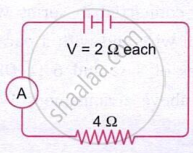
Two cells each having an e.m.f. of 2 V and an internal resistance of \(2,\Omega\) are connected in series as shown in Fig. What is the current flowing through the circuit in each case?
My mother was operating washing machine on Sunday morning. Suddenly, she saw a spark coming out of the electric board and the electric current in the house failed. An electrician was called to look into the matter. What should he have noticed.
State the condition when it is advantageous to connect cells in series.
The value used for practical measurement of Alternating Current is the:
