Advertisements
Advertisements
प्रश्न
Advertisements
उत्तर
The fuse helps to control the maximum current in an electrical circuit. The fuse protects an electrical circuit by melting and breaking the circuit, whenever the current exceeds the pre-determined limit in the circuit. Due to low melting point, the fuse wire melts and then breaks the circuit.
APPEARS IN
संबंधित प्रश्न
In 10 s, charge of 25 C leaves a battery, and 200 J of energy are delivered to an outside circuit a result.
What current flows from the battery?
What happens to the other bulbs in a parallel circuit if one bulb blows off?
The following table shows the current in Amperes and potential differences in Volts.
- Find the average resistance.
- What will be the nature of the graph between the current and potential difference? (Do not draw a graph.)
- Which law will the graph prove? Explain the law.
| V (volts) | I (amp) |
| 4 | 9 |
| 5 | 11.25 |
| 6 | 13.5 |
If a charge of 420 C flows through a conducting wire in 5 minutes what is the value of the current?
Complete the following sentence:
Fuse wire has a ............ Melting point and it is made of an alloy of ......... and if the current in a circuit rises too high, the fuse wire ...........
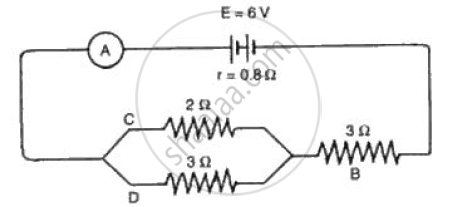
The circuit diagram (Fig.) shows a battery of e.m.f. 6 volts and internal
resistance of 0.8 Ω oonnected in series. Find the
(a) Current reoorded by the ammeter,
(b) P.d. across the terminals of the resistor B,
( c) Current passing through each of the resistors B, C and D, and
( d) P.d. across the terminals of the battery.
When an electric current is passed, electrons move from:
A charge of 400C flows through a conductor for 13 minutes and 20 seconds. Find the magnitude of the current flowing through the conductor.
What happens when the switch in a circuit is turned OFF (open circuit)?
