Advertisements
Advertisements
प्रश्न
Define the following:
Super conductors
Advertisements
उत्तर
Substances whose resistance decreases tremendously with decreasing temperature and reaches nearly zero near absolute zero are called superconductors; e.g., lead, tin, etc.
APPEARS IN
संबंधित प्रश्न
What is the conventional direction of the flow of electric current? How does it differ from the direction of flow electrons?
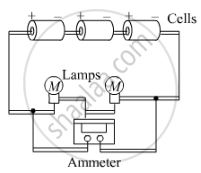
A student made an electric circuit shown here to measure the current through two lamps.
Are the lamps in series or parallel?
(a) Are the lamps in series or parallel?
(b) The student has made a mistake in this circuit. What is the mistake?
(c) Draw a circuit diagram to show the correct way to connect the circuit. Use the proper circuit symbols in your diagram.
Give three reasons why different electrical appliances in a domestic circuit are connected in parallel.
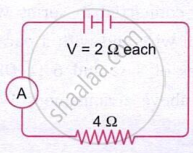
Two cells each having an e.m.f. of 2 V and an internal resistance of \(2,\Omega\) are connected in series as shown in Fig. What is the current flowing through the circuit in each case?
An electric kettle has a heating element which is rated at 2 kW when connected to a 250 V electric supply. Calculate the
(a) Current which flows in the element when it is connected to a 250 V supply,
(b) Resistance of the filament,
(c) Heat produced in 1 minute by the element,
(d) Cost of running the kettle for 10 minutes a day for 30 days of the month, at the rate of Rs. 3.00 per unit.
State whether the following statement is True or False:
The SI unit of charge is the coulomb.
A continuous and closed path of an electric current is called:
In ionised gases (plasma), the charge carriers are:
