Advertisements
Advertisements
प्रश्न
Advertisements
उत्तर
The rate of movement of charge from one point to another through a section of the conductor is called electric current. Current refers to rate of flow of charges in a conductor.
I = Q/t
संबंधित प्रश्न
Why are metals good conductors of electricity whereas glass is a bad conductor of electricity? Give reason?
Which of the following equation shows the correct relationship between electrical unit?
1A = 1C/s or 1c= 1A/s
A p.d. of 6 V is applied to two resistors of 3 Ω and 6 Ω connected in parallel. Calculate:
(a) the combined resistance
(b) the current flowing in the main circuit
(c) the current flowing in the 3 Ω resistor.
Draw a circuit diagram showing two lamps, one cell and a switch connected in series.
How can you change the brightness of the lamp?
If a charge of 420 C flows through a conducting wire in 5 minutes what is the value of the current?
Electrical appliances have voltage and power ratings as listed below. Which
has the larger working resistance?
| Appliances | Voltage (V) | Power (W) |
| (a) Washing machine | 250 | 3000 |
| ( b) Television | 240 | 160 |
| (c)240 | 240 | 1500 |
| ( d) Hair curler | 250 | 20 |
| ( e) Car head lamp | 12 | 36 |
Answer the following question.
An electric lamp of resistance 20 Ω and a conductor of resistance 4 0 are connected to a 6 V battery as shown in the circuit. Calculate: 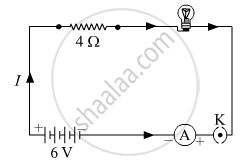
(a) the total resistance of the circuit,
(b) the current through the circuit,
(c) the potential difference across the (i) electric lamp and (ii) conductor, and
(d) power of the lamp.
State the conditions for the flow of charge in a circuit from one point to the other.
Calculate the current in a wire if a charge of 1500 coulomb flows through it in 5 minutes.
Electric current flows through a circuit only when:
