Advertisements
Advertisements
प्रश्न
Give three reasons why different electrical appliances in a domestic circuit are connected in parallel.
Advertisements
उत्तर
Three reasons why a parallel circuit is used in domestic wiring:
(a) A parallel circuit has a low resistance.
(b) It prevents unequal power supply as opposed to a series circuit.
(c) If one device in the series is damaged, it does not affect the other devices.
APPEARS IN
संबंधित प्रश्न
Which of the following units could be used to measure electric charge?
(a) ampere
(b) joule
(c) volt
(d) coulomb
The atoms of copper contain electrons and the atoms of rubber also contain electrons. Then why does copper conduct electricity but rubber does not conduct electricity?
<p> Define the unit of electric current (or Define ampere).
The circuit diagram given below shows the combination of three resistors R1, R2 and R3:
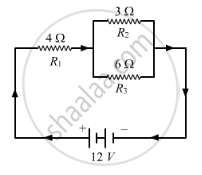
Find :
(i) total resistance of the circuit.
(ii) total current flowing in the circuit.
(iii) the potential difference across R1.
In the circuit shown below, the voltmeter reads 10 V.
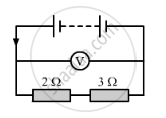
(a) What is the combined resistance?
(b) What current flows?
(c) What is the p.d. across 2 Ω resistor?
(d) What is the p.d. across 3 Ω resistor?
Ten bulbs are connected in a series circuit to a power supply line. Ten identical bulbs are connected in a parallel circuit to an identical power supply line.
(b) In which circuit, if one bulbs be brighter?
How does the heat H produced by a current passing through a fixed resistance wire depend on magnitude of current I?
Tick(✓) the correct choice in the following:
Which of the following quantities has the same value for all electrical
appliances connected to the ring main circuit in a house?
Tick(✓) the correct choice in the following:
A three pin plug is connected to the lead for a 1 kW electric iron to be
used on a 250 V supply. Which of the following statements is not correct?
Define the following:
Electromotive force
What is the purpose of a fuse in an electrical circuit?
If a fuse contains a 5 A fuse wire and the voltage is 240 V, what is the maximum power (wattage) which may be taken from the circuit?
1 kWh = `(1 "volt" xx 1 "ampere" xx "_________")/1000`
Fill in the blank :
1 mA = ............................. A.
Define an electric current.
Problems for practice:
If 3A current flows through a circuit, then convert the current in terms of a milliampere.
In electrolytes, the ions carrying charge move toward:
