Advertisements
Advertisements
Question
Give three reasons why different electrical appliances in a domestic circuit are connected in parallel.
Advertisements
Solution
Three reasons why a parallel circuit is used in domestic wiring:
(a) A parallel circuit has a low resistance.
(b) It prevents unequal power supply as opposed to a series circuit.
(c) If one device in the series is damaged, it does not affect the other devices.
APPEARS IN
RELATED QUESTIONS
Fill in the blank:
To increase the effective resistance in a circuit the resistors are connected in _____________.
Draw the electrical symbols of the following components and state its use:
Rheostat (variable resistance)
The work done in moving a unit charge across two points in an electric circuit is a measure of ______.
If the amount of electric charge passing through a conductor in 10 minutes is 300 C, the current flowing is:
(a) 30 A
(b) 0.3 A
(c) 0.5 A
(d) 5 A
State the factors on which the strength of electric current flowing in a given conductor depends.
The circuit diagram given below shows the combination of three resistors R1, R2 and R3:
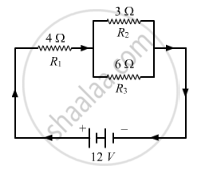
Find :
(i) total resistance of the circuit.
(ii) total current flowing in the circuit.
(iii) the potential difference across R1.
What happens to the other bulbs in a series circuit if one bulb blows off?
Ten bulbs are connected in a series circuit to a power supply line. Ten identical bulbs are connected in a parallel circuit to an identical power supply line.
(c) In which circuit, if one bulb blows out, all other will stop glowing?
Using the circuit given below, state which of the following statement is correct?
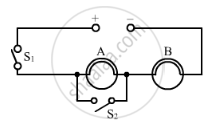
(a) When S1 and S2 are closed, lamps A and B are lit.22
(b) With S1 open and S2 closed, A is lit and B is not lit.
(c) With S2 open and S1 closed A and B are lit.
(d) With S1 closed and S2 open, lamp A remains lit even if lamp B gets fused.
Consider the circuit given below when A, B and C are three identical light bulbs of constant resistance. 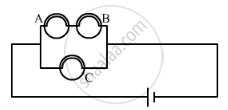
(a) List the bulbs in order of increasing brightness.
(b) If C burns out, what will be the brightness of A now compared with before?
(c) If B burns out instead, what will be the brightness of A and C compared with before?
If the current passing through a conductor is doubled, what will be the change in heat produced
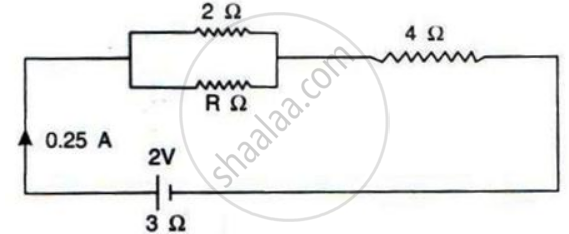
The following circuit diagram shows three resistors 2 Ω, 4 Ω and R Ω connected to a battery of e.m.f 2V and internal resistance 3 Ω. If the main current of 0.25 A flows through the circuit, find:
- the p.d. across the 4 Ω resistors,
- the p.d. across the internal resistance of the cell,
- the p.d. across the R Ω or 2 Ω resistors, and
- the value of R.
Calculate the amount of energy transferred by a 10 A electric current flowing through a resistor of 5 o for 15 minutes.
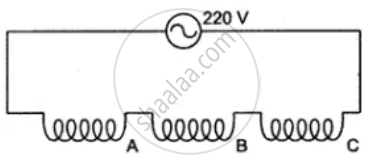
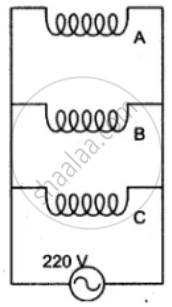
The diagram shows two ways of connecting three lamps P, Q and R to A.C. supply of 220 V.
Define the following:
Semiconductors
An electric bulb is rated 250 W, 230 V.
- the energy consumed in one hour, and
- the time in which the bulb will consume 1.0 kWh energy when connected to 230 V mains.
Three resistances, of which two are equal when connected in series have an effective resistance of 30 ohms. When the three resistances are connected in parallel, the effective resistances is 3 ohms. Find the values of the individual resistances.
The SI unit of electric current is:
Conventional current is defined as the direction in which which type of charge would flow?
The number of electrons required to produce a total charge of 1.6 C is:
