Advertisements
Advertisements
Question
You can given one hundred 1 Ω resistors. What is the smallest and largest resistance you can make in a circuit using these?
Advertisements
Solution
Given: One hundred 1 Ω resistors
The largest value of resistance is obtained when the resistors are connected in series. Therefore, the largest resistance is 100 Ω.
The lowest resistance is obtained when all the resistors are connected in parallel. Therefore, the lowest resistance of the combination is 0.01 Ω.
APPEARS IN
RELATED QUESTIONS
Three 2 V cells are connected in series and used as a battery in a circuit.
- What is the p.d. at the terminals of the battery?
- How many joules of electrical energy does 1 C gain on passing through
- one cell
- all three cells?
The atoms of copper contain electrons and the atoms of rubber also contain electrons. Then why does copper conduct electricity but rubber does not conduct electricity?
By what name is the physical quantity coulomb/second called?
What is the current in a circuit if the charge passing each point is 20 C in 40 s?
In 10 s, a charge of 25 C leaves a battery, and 200 J of energy are delivered to an outside circuit as a result.
- What is the p.d. across the battery?
- What current flows from the battery?
If the amount of electric charge passing through a conductor in 10 minutes is 300 C, the current flowing is:
(a) 30 A
(b) 0.3 A
(c) 0.5 A
(d) 5 A
A 5 V battery is connected to two 20 Ω resistors which are joined together in series.
(a) Draw a circuit diagram to represent this. Add an arrow to indicate the direction of conventional current flow in the circuit.
(b) What is the effective resistance of the two resistors?
(c) Calculate the current that flows from the battery?
(d) What is the p.d. across each resistor?
The figure given below shows an electric circuit in which current flows from a 6 V battery through two resistors.
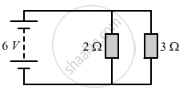
- Are the resistors connected in series with each other or in parallel?
- For each resistors, state the p.d. across it.
- The current flowing from the battery is shared between the two resistors. Which resistor will have bigger share of the current?
- Calculate the effective resistance of the two resistors.
- Calculate the current that flows from the battery.
Name two devices which work on the heating effect of electric current.
A bulb marked 12 V, 24 W operates on a 12 volt car battery for 20 minutes. Calculate:
(i) The current flowing through it, and
(ii) The energy liberated.
The diagram shows two ways of connecting three lamps P, Q and R to A.C. supply of 220 V.
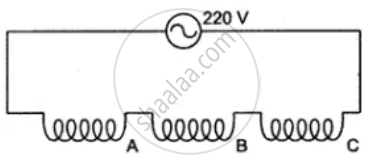
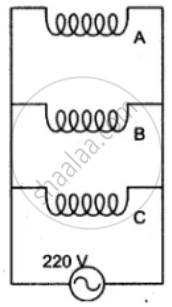
If a fuse contains a 5 A fuse wire and the voltage is 240 V, what is the maximum power (wattage) which may be taken from the circuit?
An electric bulb is rated '100 W, 250 V'. How much current will the bulb draw if connected to a 250 V supply?
Three heaters each rated 250 W, 100 V are connected in parallel to a 100 V supply. Calculate :
The total current taken from the supply
Kilowatt hour is the unit of
In electrolytes, the ions carrying charge move toward:
