Advertisements
Advertisements
Question
What actually travels through the wires when you switch on a light?
Advertisements
Solution
When we switch on a light, electrons travel through the wires. The flow of these electrons is called electric current.
APPEARS IN
RELATED QUESTIONS
What Makes an Electric Current Flow in a Wire?
Which statement/statement is/are correct?
1. An ammeter is connected in series in a circuit and a voltmeter is connected in parallel.
2. An ammeter has a high resistance.
3. A voltmeter has a low resistance.
(a) 1, 2, 3
(b) 1, 2
(c) 2, 3
(d) 1
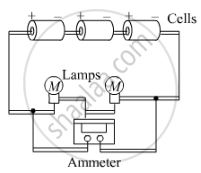
A student made an electric circuit shown here to measure the current through two lamps.
Are the lamps in series or parallel?
(a) Are the lamps in series or parallel?
(b) The student has made a mistake in this circuit. What is the mistake?
(c) Draw a circuit diagram to show the correct way to connect the circuit. Use the proper circuit symbols in your diagram.
The lamps in a house hold circuit are connected in parallel because:
(a) this way they required less current
(b) if one lamp fails the others remain lit
(c) this way they require less power
(d) if one lamp fails the other also fail
If a charge of 420 C flows through a conducting wire in 5 minutes what is the value of the current?
An electric current flowing in a wire creates ______ around the wire.
A 720 W heater operates from a 220 V line voltage. Calculate:
(a) The electrical energy consumed by the heater in 3 h.
(b) The cost of electrical energy consumption at the rate of 60 paise per kWh.
The diagram shows two ways of connecting three lamps P, Q and R to A.C. supply of 220 V.
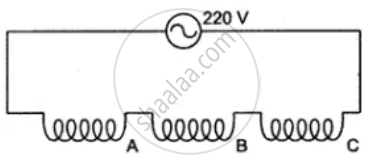
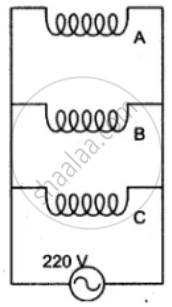
Tick(✓) the correct choice in the following:
When the length of a conductor is doubled the resistance of the conductor
will
An electric oven is rated as 1.5 kW, 250 V. If it is connected to a 250 V mains, calculate the
(a) Current drawn,
(b) Energy consumed in 20 hours,
(c) Cost of energy consumed in 20 hours at the rate of Re. 1 per unit.
Explain, why the potential difference across the terminals of a cell is more when the cell is not in use than it is when the cell is being used.
Which part of an electrical appliance is earthed?
In current electricity, a positive charge refers to ______.
Match the items in column-I to the items in column-II:
| Column - I | Column - II | ||
| (i) | electric current | (a) | volt |
| (ii) | potential difference | (b) | ohm meter |
| (iii) | specific resistance | (c) | watt |
| (iv) | electrical power | (d) | joule |
| (v) | electrical energy | (e) | ampere |
- What is meant by electric current?
- Name and define its unit.
- Which instrument is used to measure the electric current? How should it be connected in a circuit?
Electric current passes through a metallic conductor due to the movement of ______.
Assertion (A): Electric current will not flow between two charged bodies when connected if their charges are the same.
Reason (R): Current is the rate of flow of charge.
Define the following:
Conventional current
