Advertisements
Advertisements
Question
Which particles constitute the electric current in a metallic conductor?
Advertisements
Solution
The flow of negatively charged particles (electrons) in a metallic conductor constitutes electric current.
APPEARS IN
RELATED QUESTIONS
Calculate the number of electrons constituting one coulomb of charge.
The work done in moving a unit charge across two points in an electric circuit is a measure of ______.
Three 2 V cells are connected in series and used as a battery in a circuit.
- What is the p.d. at the terminals of the battery?
- How many joules of electrical energy does 1 C gain on passing through
- one cell
- all three cells?
A flash of lighting carries 10 C of charge which flows for 0.01 s. What is the current? If the voltage is 10 MV, what is the energy?
If the current through a floodlamp is 5 A, what charge passed in 10 seconds?
(a) 0.5 C
(b) 2 C
(c) 5 C
(d) 50 C
A p.d. of 6 V is applied to two resistors of 3 Ω and 6 Ω connected in parallel. Calculate:
(a) the combined resistance
(b) the current flowing in the main circuit
(c) the current flowing in the 3 Ω resistor.
You can given one hundred 1 Ω resistors. What is the smallest and largest resistance you can make in a circuit using these?
What happens to the other bulbs in a parallel circuit if one bulb blows off?
Using the circuit given below, state which of the following statement is correct?
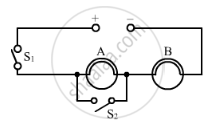
(a) When S1 and S2 are closed, lamps A and B are lit.22
(b) With S1 open and S2 closed, A is lit and B is not lit.
(c) With S2 open and S1 closed A and B are lit.
(d) With S1 closed and S2 open, lamp A remains lit even if lamp B gets fused.
Name two devices which work on the heating effect of electric current.
A charge of 80 C flows in a conductor for 2 minutes.
(a) Calculate the current flowing through the conductor.
(b) If the current through a heater is 4 A what charge must be passing in 8 seconds?
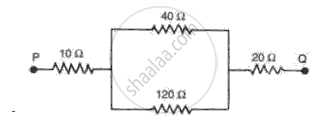
Find the effective resistance in the following circuit diagrams (Fig.):
What is the purpose of a fuse in an electrical circuit?
Explain with the help of a diagram how does 'short circuiting' occur in an electric kettle.
A wire is passed through a piece of cardboard as shown in fig .. An electric current flows vertically down the wire and then flows back up. The two sections of the write are observed to repel each other.
(a) Wi th the aid of a diagram, describe how you would plot the magnetic field lines on the card .
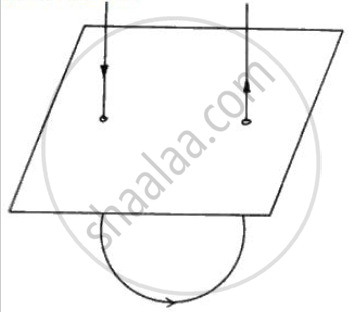
(b) Sketch the magnetic field patterns around both the sections of the wire. Use your sketch to explain why the two sections repel each other.
(c) The repulsive force between the two sections is small. What changes could be made to increase it?
An electric kettle is rated 2.5 kW, 250 V. Find the cost of running the kettle for two hours at Rs. 5.40 per unit.
State the conditions for the flow of charge in a circuit from one point to the other.
Name any two devices, which are working on the heating effect of the electric current.
Which of the following is the example expression for Alternating Current?
