Advertisements
Advertisements
प्रश्न
Which particles constitute the electric current in a metallic conductor?
Advertisements
उत्तर
The flow of negatively charged particles (electrons) in a metallic conductor constitutes electric current.
APPEARS IN
संबंधित प्रश्न
Draw the electrical symbols of the following components and state its use:
Ammeter.
State the factors on which the strength of electric current flowing in a given conductor depends.
What happens to the other bulbs in a parallel circuit if one bulb blows off?
State the S.I. unit of current.
Two resistors of 2.0 Ω and 3.0 Ω are connected (a) in series (b) in parallel, with a battery of 6.0 V and negligible internal resistance. For each case draw a circuit diagram and calculate the current through the battery.
A wire of length 5 m has a resistance of 2.0 Ω calculate:
(a) the resistance of wire of length 1 m
(b) the equivalent resistance if two such wires each of length 2 m are joined in parallel.
(c) the resistance of 1 m length of wire of same material but of half diameter.
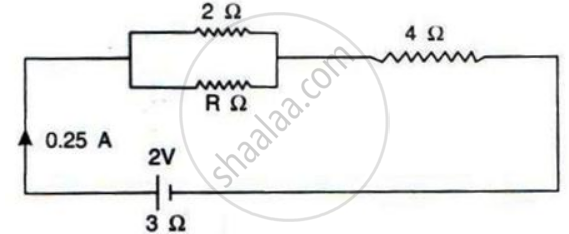
The following circuit diagram shows three resistors 2 Ω, 4 Ω and R Ω connected to a battery of e.m.f 2V and internal resistance 3 Ω. If the main current of 0.25 A flows through the circuit, find:
- the p.d. across the 4 Ω resistors,
- the p.d. across the internal resistance of the cell,
- the p.d. across the R Ω or 2 Ω resistors, and
- the value of R.
The work done in moving unit positive charge across two points in an electric circuit is a measure of
What is the criteria for selecting a fuse wire?
A 3 pin mains plug is fitted to the lead for a 1 kW electric kettle to be used on a 250 V A.C. supply. Which of the following statements is NOT correct?
(a) A 13 A fuse is the most appropriate value to use.
(b) The brown wire should be connected to the live side of the mains.
What is the function of a step-up transformer?
Fig . shows the core of a transformer and i ts input and output connections
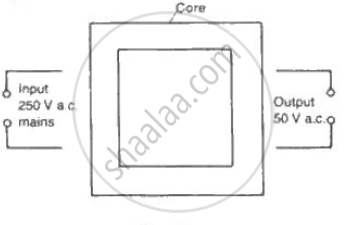
State the material used for the core and describe th e structure of the core.
(a) Use the values given in the diagram to calculate the turns ratio for the transformer and connections, labeling all parts of the diagram .
(b) If a current of 2 A is taken from th e output, calculate th e current in the input circuit (Assume the transformer to be ideal ).
When an electric current is passed, electrons move from:
Assertion (A): Electric current will not flow between two charged bodies when connected if their charges are the same.
Reason (R): Current is the rate of flow of charge.
In semiconductors, the charge carriers are:
What happens when the switch in a circuit is turned OFF (open circuit)?
In the process of current flow through a conductor, the amount of charge passing per unit time gives:
