Advertisements
Advertisements
प्रश्न
Which particles constitute the electric current in a metallic conductor?
Advertisements
उत्तर
The flow of negatively charged particles (electrons) in a metallic conductor constitutes electric current.
APPEARS IN
संबंधित प्रश्न
Why are metals good conductors of electricity whereas glass is a bad conductor of electricity? Give reason?
Ten bulbs are connected in a series circuit to a power supply line. Ten identical bulbs are connected in a parallel circuit to an identical power supply line.
(c) In which circuit, if one bulb blows out, all other will stop glowing?
The rating of a fuse connected in the lighting circuit is ______.
Find the effective resistance in the following circuit diagrams (Fig.):
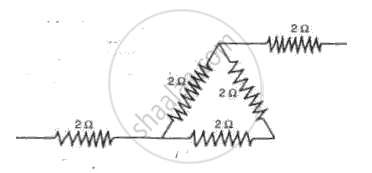
In a house there are 6 bulbs of 100 W each used for 4 hours a day, 4 bulbs of 60 W each used for 8 hours a day, an immersion heater of 2.5 kW used for 1 hour per day, and an electric iron of 800 W used for 2 hours per day. Calculate the cost of monthly electric bill for the month of April at the rate of 80 p per unit.
Fig . shows the core of a transformer and i ts input and output connections
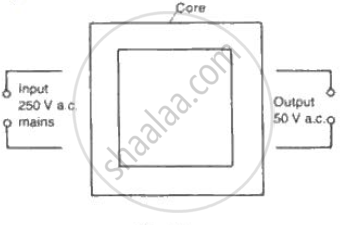
State the material used for the core and describe th e structure of the core.
(a) Use the values given in the diagram to calculate the turns ratio for the transformer and connections, labeling all parts of the diagram .
(b) If a current of 2 A is taken from th e output, calculate th e current in the input circuit (Assume the transformer to be ideal ).
Three heaters each rated 250 W, 100 V are connected in parallel to a 100 V supply of the energy supplied in kWh to the three heaters in 5 hours.
A bulb is connected to a battery of p.d. 4 V and internal resistance 2.5 Ω . A steady current of 0.5 A flows through the circuit. Calculate:
The energy dissipated in the bulb in 10 minutes.
Which part of an electrical appliance is earthed?
______ is used to measure the electric current.
The SI unit for electric current is the coulomb.
What are the effects of electric current?
Define the following:
Conventional current
In electrolytes such as salt solutions, the charge carriers are:
