Advertisements
Advertisements
प्रश्न
What actually travels through the wires when you switch on a light?
Advertisements
उत्तर
When we switch on a light, electrons travel through the wires. The flow of these electrons is called electric current.
APPEARS IN
संबंधित प्रश्न
Which particles constitute the electric current in a metallic conductor?
In which direction does conventional current flow around a circuit?
If 20 C of charge pass a point in a circuit in 1 s, what current is flowing?
Which unit could be used to measure current?
(a) Watt
(b) Coulomb
(c) Volt
(d) Ampere
The figure given below shows an electric circuit in which current flows from a 6 V battery through two resistors.
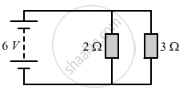
- Are the resistors connected in series with each other or in parallel?
- For each resistors, state the p.d. across it.
- The current flowing from the battery is shared between the two resistors. Which resistor will have bigger share of the current?
- Calculate the effective resistance of the two resistors.
- Calculate the current that flows from the battery.
Which type of circuit, series or parallel, is preferred while connecting a large number of bulbs:
(b) for lighting inside the rooms of the hotel?
Tell the odd one out. Give a proper explanation.
A charge of 80 C flows in a conductor for 2 minutes.
(a) Calculate the current flowing through the conductor.
(b) If the current through a heater is 4 A what charge must be passing in 8 seconds?
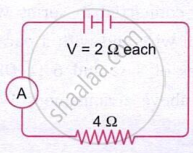
Two cells each having an e.m.f. of 2 V and an internal resistance of \(2,\Omega\) are connected in series as shown in Fig. What is the current flowing through the circuit in each case?
A 3 pin mains plug is fitted to the lead for a 1 kW electric kettle to be used on a 250 V A.C. supply. Which of the following statements is NOT correct?
(a) A 13 A fuse is the most appropriate value to use.
(b) The brown wire should be connected to the live side of the mains.
Electrical power P is given by the expression P = (Q × V) ÷ time
(a) What do the symbols Q and V represent?
(b) Express the power P in terms of current and resistance explaining the meanings of symbols used there in.
An electric bulb is rated 250 W, 230 V.
- the energy consumed in one hour, and
- the time in which the bulb will consume 1.0 kWh energy when connected to 230 V mains.
A geyser is rated 1500 W, 250 V. This geyser is connected to 250 V mains. Calculate:
- The current drawn,
- The energy consumed in 50 hours, and
- The cost of energy consumed at ₹ 4.20 per kWh.
One unit of electrical energy consumed is equal to 1000 kilowatt-hour.
What are the effects of electric current?
In metallic conductors, the charge carriers responsible for producing electric current are:
