Advertisements
Advertisements
प्रश्न
What actually travels through the wires when you switch on a light?
Advertisements
उत्तर
When we switch on a light, electrons travel through the wires. The flow of these electrons is called electric current.
APPEARS IN
संबंधित प्रश्न
Which particles constitute the electric current in a metallic conductor?
State the factors on which the strength of electric current flowing in a given conductor depends.
An electric circuit consisting of a 0.5 m long nichrome wire XY, an ammeter, a voltmeter, four cells of 1.5 V each and a plug key was set up.
(i) Draw a diagram of this electric circuit to study the relation between the potential difference maintained between the points 'X' and 'Y' and the electric current flowing through XY.
In the circuit diagram given below five resistances of 10 Ω, 40 Ω, 30 Ω, 20 Ω, and 60 Ω are connected as shown to a 12 V battery.
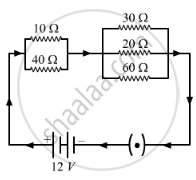
Calculate:
(a) total resistance in the circuit.
(b) total current flowing in the circuit.
Consider the circuit given below when A, B and C are three identical light bulbs of constant resistance. 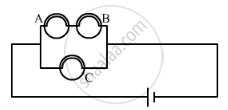
(a) List the bulbs in order of increasing brightness.
(b) If C burns out, what will be the brightness of A now compared with before?
(c) If B burns out instead, what will be the brightness of A and C compared with before?
Calculate the effective resistance between the points A and B in the network shown below in Figure 8.45
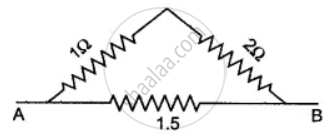
A wire of length 5 m has a resistance of 2.0 Ω calculate:
(a) the resistance of wire of length 1 m
(b) the equivalent resistance if two such wires each of length 2 m are joined in parallel.
(c) the resistance of 1 m length of wire of same material but of half diameter.
Draw a schematic diagram of an electric circuit consisting of a battery of two cells each of 1.5 V, 5 Ω, 10 Ω and 15 Ω resistors and a plug key, all connected in series.
Define the following:
Semiconductors
Tick (✓) the correct choice among the following :
There are 500 turns and 2000 turns in the primary and secondary coil of a
transformer respectively. If th e output voltage is 1000 V, how large is the
input voltage?
A geyser is rated 1500 W, 250 V. This geyser is connected to 250 V mains. Calculate:
- The current drawn,
- The energy consumed in 50 hours, and
- The cost of energy consumed at ₹ 4.20 per kWh.
State expression for Cells connected in series.
Coulomb is the SI unit of ____________.
The number of electrons constituting a 1-coulomb charge is ______.
For current to flow, one needs art open circuit.
Calculate the current in a wire if a charge of 1500 coulomb flows through it in 5 minutes.
The value used for practical measurement of Alternating Current is the:
In the process of current flow through a conductor, the amount of charge passing per unit time gives:
