Advertisements
Advertisements
प्रश्न
Match the pairs.
| ‘A’ Group | ‘B’ Group |
| 1. Free electrons | a. V/R |
| 2. Current | b. Increases the resistance in the circuit |
| 3. Resistivity | c. Weakly attached |
| 4. Resistances in series | d. VA/LI |
Advertisements
उत्तर
| ‘A’ Group | Answer |
| 1. Free electrons | c. Weakly attached |
| 2. Current | a. V/R |
| 3. Resistivity | d. VA/LI |
| 4. Resistances in series | b. Increases the resistance in the circuit |
APPEARS IN
संबंधित प्रश्न
Compare how an ammeter and a voltmeter are connected in a circuit.
V1, V2 and V3 are the p.ds. across the 1Ω, 2Ω and 3Ω resistors in the following diagram, and the current is 5 A.
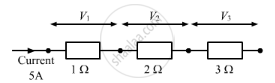
Which one of the columns (a) to (d) shows the correct values of V1, V2 and V3measured in volts?
`V_1` `V_2` `V_3`
(a) 1.0 2.0 3.0
(b) 5.0 10.0 15.0
(c) 5.0 2.5 1.6
(d) 4.0 4.0 2.0
Ten bulbs are connected in a series circuit to a power supply line. Ten identical bulbs are connected in a parallel circuit to an identical power supply line.
(c) In which circuit, if one bulb blows out, all other will stop glowing?
Consider the circuit given below when A, B and C are three identical light bulbs of constant resistance. 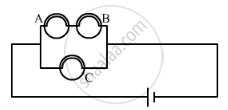
(a) List the bulbs in order of increasing brightness.
(b) If C burns out, what will be the brightness of A now compared with before?
(c) If B burns out instead, what will be the brightness of A and C compared with before?
Two lamps, one rated 40 W at 220 V and the other 60 W at 220 V, are connected in parallel to the electric supply at 220 V.
(a) Draw a circuit diagram to show the connections.
(b) Calculate the current drawn from the electric supply.
(c) Calculate the total energy consumed by the two lamps together when they operate for one hour.
Two resistors of 2.0 Ω and 3.0 Ω are connected (a) in series (b) in parallel, with a battery of 6.0 V and negligible internal resistance. For each case draw a circuit diagram and calculate the current through the battery.
Calculate the amount of energy transferred by a 10 A electric current flowing through a resistor of 5 o for 15 minutes.
The diagram shows two ways of connecting three lamps P, Q and R to A.C. supply of 220 V.
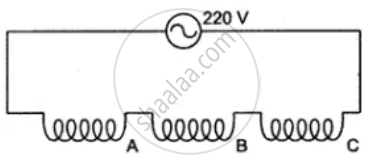
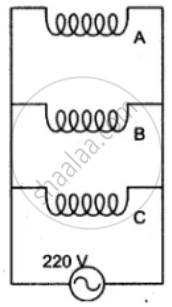
A current of 0.2 A flows through a wire whose ends are at a potential difference of 15 V. Calculate:
(i) The resistance of the wire, and
(ii) The heat energy produced in 1 minute.
At the time of short circuit, the electric current in the circuit ______.
Answer the following question.
What is the function of a galvanometer in a circuit?
How is direction of current related to the direction of flow of electrons?
Give the electric current unit.
Which of the following represents voltage?
What are the effects of electric current?
A current of 2A passing through the conductor produces 80 J of heat in 10 seconds. The resistance of the conductor is ______.
