Advertisements
Advertisements
प्रश्न
Which of the following represents voltage?
पर्याय
`("Work done")/("Current" xx "Time")`
Work done × Charge
`("Work done" xx "Time")/"Current"`
Work done × Charge × Time
Advertisements
उत्तर
`("Work done")/("Current" xx "Time")`
Explanation -
Potential difference (V) is defined as the ratio of work done (W) and charge (Q).
`"V" = "W"/"Q"`
Q = i × t
Charge is defined as
Q = i × t
where i = current
t = time
So,
`"V" = "W"/("i" xx "t")`
`"Voltage" = ("Work done")/("Current" xx "Time")`
APPEARS IN
संबंधित प्रश्न
1 A = _________ mA
- 102
- 103
- 10-3
- 10-6
The work done in moving a unit charge across two points in an electric circuit is a measure of ______.
Which of the following units could be used to measure electric charge?
(a) ampere
(b) joule
(c) volt
(d) coulomb
Three 2 V cells are connected in series and used as a battery in a circuit.
How many joules of electrical energy does 1 C gain on passing through (i) one cell (ii) all three cells?
An electric circuit consisting of a 0.5 m long nichrome wire XY, an ammeter, a voltmeter, four cells of 1.5 V each and a plug key was set up.
(i) Draw a diagram of this electric circuit to study the relation between the potential difference maintained between the points 'X' and 'Y' and the electric current flowing through XY.
What happens to the other bulbs in a parallel circuit if one bulb blows off?
Which effect of current is utilised in the working of an electric fuse?
Calculate the equivalent resistance between A and B in the adjacent diagram.
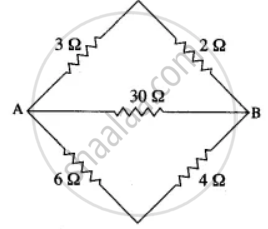
In the network shown in the following adjacent Figure, calculate the equivalent resistance between the points.
- A and B
- A and C

How is direction of current related to the direction of flow of electrons?
When an electric current is passed, electrons move from:
1020 electrons, each having a charge of 1.6 x 10⁻¹⁹ C, flows in a circuit V is 0.1s. What is the current in ampere?
Electric current is defined as:
Common sources of Direct Current (DC) are:
