Advertisements
Advertisements
प्रश्न
The work done in moving a unit charge across two points in an electric circuit is a measure of ______.
पर्याय
current
potential difference
resistance
power
Advertisements
उत्तर
The work done in moving a unit charge across two points in an electric circuit is a measure of potential difference.
संबंधित प्रश्न
Choose the correct alternative and rewrite the following sentence.
When the resistance of a conductor increases, the current will ________ increase.
One coulomb charge is equivalent to the charge contained in:
(a) 2.6 × 10¹⁹ electrons
(b) 6.2 × 10¹⁹ electrons
(c) 2.65 × 10¹⁸ electrons
(d) 6.25 × 10¹⁸ electrons
In which direction does conventional current flow around a circuit?
What Makes an Electric Current Flow in a Wire?
Which statement/statement is/are correct?
1. An ammeter is connected in series in a circuit and a voltmeter is connected in parallel.
2. An ammeter has a high resistance.
3. A voltmeter has a low resistance.
(a) 1, 2, 3
(b) 1, 2
(c) 2, 3
(d) 1
State the factors on which the strength of electric current flowing in a given conductor depends.
What happens to the other bulbs in a parallel circuit if one bulb blows off?
How do you think the brightness of two lamps arranged in parallel compares with the brightness of two lamps arranged in series (both arrangements having one cell)?
Tell the odd one out. Give a proper explanation.
Complete the following sentence:
Fuse wire has a ............ Melting point and it is made of an alloy of ......... and if the current in a circuit rises too high, the fuse wire ...........
Tick(✓) the correct choice in the following:
A three pin plug is connected to the lead for a 1 kW electric iron to be
used on a 250 V supply. Which of the following statements is not correct?
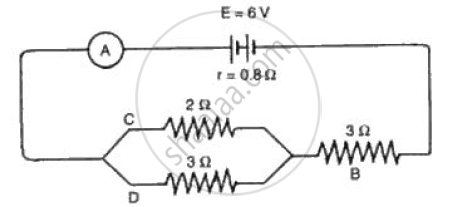
The circuit diagram (Fig.) shows a battery of e.m.f. 6 volts and internal
resistance of 0.8 Ω oonnected in series. Find the
(a) Current reoorded by the ammeter,
(b) P.d. across the terminals of the resistor B,
( c) Current passing through each of the resistors B, C and D, and
( d) P.d. across the terminals of the battery.
Complete the following table. The first answer has been given as an example.
| Quantity | Unit | |
| (a) | Electrical potential | volt |
| (b) | Resistance | ........ |
| (c) | Power | ........ |
| (d) | Energy | ........ |
| (e) | Resistivity | ........ |
Fig. shows a 3 pin plug with the cover removed. The electric cable
connected to the plug contains 3 wires with colour coded insulation namely brown, blue and green.
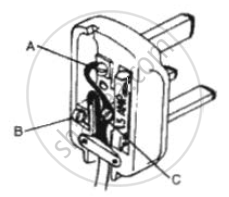
- Identify each of the colour coded wires by stating to which of the
terminals A, B or C in the diagram they should be connected. - Identify the terminal through which no current passes in normal
circumstances. - What is the purpose of the earthed wire connected to an electric
appliance like an electric heater? Describe how it works.
An electric oven is rated as 1.5 kW, 250 V. If it is connected to a 250 V mains, calculate the
(a) Current drawn,
(b) Energy consumed in 20 hours,
(c) Cost of energy consumed in 20 hours at the rate of Re. 1 per unit.
An electric bulb is marked '100 W, 250 V'. What information does this convey?
An electric bulb is rated at 220 V, 100 W.
- What is its resistance?
- What safe current can be passed through it?
Fill in the blank :
1 mA = ............................. A.
An electrical gadget can give an electric shock to its user under certain circumstances. Mention any two of these circumstances.
Small amounts of electrical current are measured in milliampere (mA). How many milliampere are there in 0.25 A ?
A current of 1 A is drawn by a filament of an electric bulb. Number of electrons passing through a cross section of the filament in 16 seconds would be roughly
1020 electrons, each having a charge of 1.6 x 10⁻¹⁹ C, flows in a circuit V is 0.1s. What is the current in ampere?
Find the odd one out.
Loudspeaker, Bar magnet/magnet, Electric motor, Microphone.
A switch in an electric circuit is used to:
