Advertisements
Advertisements
प्रश्न
The work done in moving a unit charge across two points in an electric circuit is a measure of ______.
विकल्प
current
potential difference
resistance
power
Advertisements
उत्तर
The work done in moving a unit charge across two points in an electric circuit is a measure of potential difference.
संबंधित प्रश्न
<p> Define the unit of electric current (or Define ampere).
Write down the formula which relates electric charge, time and electric current
Why should the resistance of:
a voltmeter be very large?
In 10 s, a charge of 25 C leaves a battery, and 200 J of energy are delivered to an outside circuit as a result.
- What is the p.d. across the battery?
- What current flows from the battery?
Which statement/statement is/are correct?
1. An ammeter is connected in series in a circuit and a voltmeter is connected in parallel.
2. An ammeter has a high resistance.
3. A voltmeter has a low resistance.
(a) 1, 2, 3
(b) 1, 2
(c) 2, 3
(d) 1
An electric circuit consisting of a 0.5 m long nichrome wire XY, an ammeter, a voltmeter, four cells of 1.5 V each and a plug key was set up.
Following graph was plotted between V and I values:
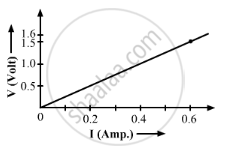
What would be the values of `V/I` rations when the potential difference is 0.8 V, 1.2 V and 1.6 V respectively?
What conclusion do you draw from these values?
What is the resistance of the wire?
An electrician has wired a house in such a way that if a lamp gets fused in one room of the house, all the lamps in other rooms of the house stop working. What is the defect in the wiring?
Distinguish between an open and a closed circuit.
The work done in moving unit positive charge across two points in an electric circuit is a measure of
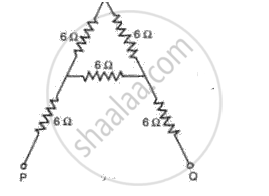
Find the effective resistance in the following circuit diagrams (Fig.):
A 3 pin mains plug is fitted to the lead for a 1 kW electric kettle to be used on a 250 V A.C. supply. Which of the following statements is NOT correct?
(a) A 13 A fuse is the most appropriate value to use.
(b) The brown wire should be connected to the live side of the mains.
Define the term kilowatt - hour and state its value in S.I. unit.
State whether the following statement is True or False:
The SI unit of charge is the coulomb.
Define an electric current.
State whether true or false. If false, correct the statement.
Current can produce magnetic field.
Unit of electric power may also be expressed as
The flow of electric charge per unit time is called potential difference.
Problems for practice:
If 5A current flows through a circuit, then convert the current in terms of microampere?
In a vacuum, the particles that can act as charge carriers are:
The value used for practical measurement of Alternating Current is the:
The RMS value of AC is defined as:
