Advertisements
Advertisements
प्रश्न
Two resistors P and Q of the same material and length but of different thickness are connected in parallel to a battery. The cross- sectional area of P is twice that of Q. What is the ratio of
(a) The resistance of P to the resistance of Q?
(b) The current in P to the current in Q?
Advertisements
उत्तर
We know that, R = ρ `1/"a"`
(a) Given length of resistors P and Q made of same material is same (say= 1)
Let 'a' be the area of cross-section of Q.
Then, the area of cross-section of Pis '2a'.
`"R"_"P"/"R"_"Q" = [ρ (1/[2"a"])]/[ρ (1/"a")] = 1/2`
the required ratio is 1: 2.
(b) AJC to ohm's law,
V=IR
If resistors P and Q are connected across the same voltage supply V, then
`"I"_"P"/"I"_"Q" = "R"_"g"/"R"_"p" = 2/1`
:. the required ratio of current in P to current in Qi s 2: 1.
APPEARS IN
संबंधित प्रश्न
A 5 V battery is connected to two 20 Ω resistors which are joined together in series.
(a) Draw a circuit diagram to represent this. Add an arrow to indicate the direction of conventional current flow in the circuit.
(b) What is the effective resistance of the two resistors?
(c) Calculate the current that flows from the battery?
(d) What is the p.d. across each resistor?
If you were going to connect two light bulbs to one battery, would you use a series or a parallel arrangement? Why? Which arrangement takes more current from the battery?
An electrician has wired a house in such a way that if a lamp gets fused in one room of the house, all the lamps in other rooms of the house stop working. What is the defect in the wiring?
A switch must be connected in ______.
A wire is passed through a piece of cardboard as shown in fig .. An electric current flows vertically down the wire and then flows back up. The two sections of the write are observed to repel each other.
(a) Wi th the aid of a diagram, describe how you would plot the magnetic field lines on the card .
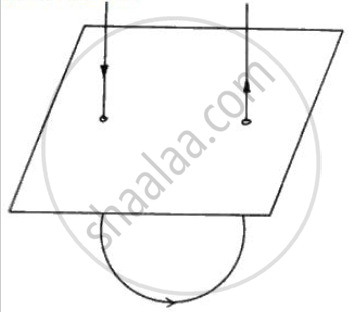
(b) Sketch the magnetic field patterns around both the sections of the wire. Use your sketch to explain why the two sections repel each other.
(c) The repulsive force between the two sections is small. What changes could be made to increase it?
An electrical appliance is rated at 1000 KVA, 220V. If the appliance is operated for 2 hours, calculate the energy consumed by the appliance in: (i) kWh (ii) joule.
When an electric current is passed, electrons move from:
Electric current passes through a metallic conductor due to the movement of ______.
A switch in an electric circuit is used to:
