Advertisements
Advertisements
प्रश्न
An electrician has wired a house in such a way that if a lamp gets fused in one room of the house, all the lamps in other rooms of the house stop working. What is the defect in the wiring?
Advertisements
उत्तर
The electrician has wired the house in a series circuit.
APPEARS IN
संबंधित प्रश्न
Which particles constitute the electric current in a metallic conductor?
In which direction does conventional current flow around a circuit?
Fill in the folloing blank with suitable words:
Current is measured in ............... using an ............... placed in ............... in a circuit.
How many electrons are flowing per second past a point in a circuit in which there is a current of 5 amp?
In the circuit diagram given below, three resistors R1, R2, and R3 of 5 Ω, 10 Ω and 30 Ω, respectively are connected as shown
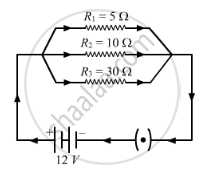
Calculate:
- current through each resistor.
- total current in the circuit.
- total resistance in the circuit.
Ten bulbs are connected in a series circuit to a power supply line. Ten identical bulbs are connected in a parallel circuit to an identical power supply line.
(c) In which circuit, if one bulb blows out, all other will stop glowing?
The rating of a fuse connected in the lighting circuit is ______.
State the relation between work, charge and potential difference for an electric circuit.
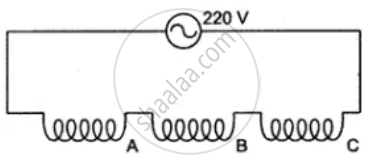
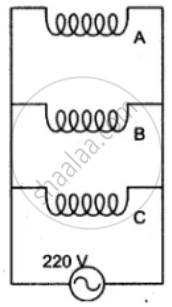
The diagram shows two ways of connecting three lamps P, Q and R to A.C. supply of 220 V.
Name the principle on which a transformer works.
State the condition when it is advantageous to connect cells in series.
Define an electric current.
Which of the following represents voltage?
A current of 2A passing through the conductor produces 80 J of heat in 10 seconds. The resistance of the conductor is ______.
Assertion (A): Electric current will not flow between two charged bodies when connected if their charges are the same.
Reason (R): Current is the rate of flow of charge.
In a vacuum, the particles that can act as charge carriers are:
A charge of 20 C flows through a conductor in 4 s. The electric current through the conductor is:
