Advertisements
Advertisements
प्रश्न
Christmas tree lamps are usually wired in series. What happens if one lamps breaks?
Advertisements
उत्तर
In a series arrangement, if a lamp blows off, the power supply to the other lamps is cut off. Hence, all the lamps will get switched off.
APPEARS IN
संबंधित प्रश्न
One coulomb charge is equivalent to the charge contained in:
(a) 2.6 × 10¹⁹ electrons
(b) 6.2 × 10¹⁹ electrons
(c) 2.65 × 10¹⁸ electrons
(d) 6.25 × 10¹⁸ electrons
What is the Flow of Charge Called?
What is an electric current?
One coulomb of charge flows through any cross-section of a conductor in 1 second. What is the current flowing through the conductor?
A battery of 9 V is connected in series with resistors of 0.2 Ω, 0.3 Ω, 0.4 Ω, 0.5 Ω and 12 Ω. How much current would flow through the 12 Ω resistor?
Complete the following sentence:
A fuse is connected in ........... with the ......... wire.
Complete the following sentence:
Fuse wire has a ............ Melting point and it is made of an alloy of ......... and if the current in a circuit rises too high, the fuse wire ...........
Tick(✓) the correct choice in the following:
The outer casing of an electric iron is generally connected to earth in order
to
Tick(✓) the correct choice in the following:
A three pin plug is connected to the lead for a 1 kW electric iron to be
used on a 250 V supply. Which of the following statements is not correct?
An electric iron is rated 750 W, 230 V. Calculate the electrical energy consumed by the press in 16 hours.
Three heaters each rated 250 W, 100 V are connected in parallel to a 100 V supply. Calculate :
The total current taken from the supply
Three heaters each rated 250 W, 100 V are connected in parallel to a 100 V supply. The resistance of each heater
An electric kettle is rated 2.5 kW, 250 V. Find the cost of running the kettle for two hours at Rs. 5.40 per unit.
Answer the following question.
An electric lamp of resistance 20 Ω and a conductor of resistance 4 0 are connected to a 6 V battery as shown in the circuit. Calculate: 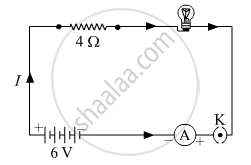
(a) the total resistance of the circuit,
(b) the current through the circuit,
(c) the potential difference across the (i) electric lamp and (ii) conductor, and
(d) power of the lamp.
Define an electric current.
Assertion (A): Electric current will not flow between two charged bodies when connected if their charges are the same.
Reason (R): Current is the rate of flow of charge.
In electrolytes such as salt solutions, the charge carriers are:
