Advertisements
Advertisements
प्रश्न
State the relation between work, charge and potential difference for an electric circuit.
Advertisements
उत्तर
The relation between work (W), charge (Q) and potential difference (V):
The work required to be done (W) to move a positive charge Q, between two points in a circuit having potential difference V, is QV. That is,
W = QV
APPEARS IN
संबंधित प्रश्न
Which is the better way to connect lights and other electrical appliances in domestic wiring: series circuits or parallel circuits? why?
Which effect of current is utilised in an electric light bulb?
Two resistors P and Q of the same material and length but of different thickness are connected in parallel to a battery. The cross- sectional area of P is twice that of Q. What is the ratio of
(a) The resistance of P to the resistance of Q?
(b) The current in P to the current in Q?
Fig. shows a 3 pin plug with the cover removed. The electric cable
connected to the plug contains 3 wires with colour coded insulation namely brown, blue and green.
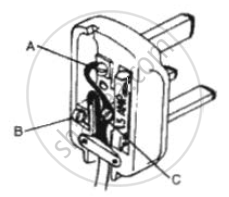
- Identify each of the colour coded wires by stating to which of the
terminals A, B or C in the diagram they should be connected. - Identify the terminal through which no current passes in normal
circumstances. - What is the purpose of the earthed wire connected to an electric
appliance like an electric heater? Describe how it works.
______ is used to measure the electric current.
- What is meant by electric current?
- Name and define its unit.
- Which instrument is used to measure the electric current? How should it be connected in a circuit?
An ammeter is always placed in parallel with the circuit.
