Advertisements
Advertisements
Question
An electrician has wired a house in such a way that if a lamp gets fused in one room of the house, all the lamps in other rooms of the house stop working. What is the defect in the wiring?
Advertisements
Solution
The electrician has wired the house in a series circuit.
APPEARS IN
RELATED QUESTIONS
Choose the correct alternative and rewrite the following sentence.
When the resistance of a conductor increases, the current will ________ increase.
What is an Ammeter? How is It Connected in a Circuit? Draw a Diagram to Illustrate Your Answer.
In 10 s, a charge of 25 C leaves a battery, and 200 J of energy are delivered to an outside circuit as a result.
- What is the p.d. across the battery?
- What current flows from the battery?
Ten bulbs are connected in a series circuit to a power supply line. Ten identical bulbs are connected in a parallel circuit to an identical power supply line.
(c) In which circuit, if one bulb blows out, all other will stop glowing?
Two lamps, one rated 40 W at 220 V and the other 60 W at 220 V, are connected in parallel to the electric supply at 220 V.
(a) Draw a circuit diagram to show the connections.
(b) Calculate the current drawn from the electric supply.
(c) Calculate the total energy consumed by the two lamps together when they operate for one hour.
Find the potential difference required to pass a current of 0.2 A in a wire of resistance 20Ω
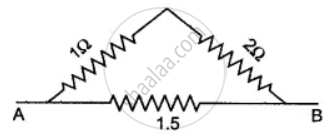
Calculate the effective resistance between the points A and B in the network shown below in Figure 8.45
Two resistors of 2.0 Ω and 3.0 Ω are connected (a) in series (b) in parallel, with a battery of 6.0 V and negligible internal resistance. For each case draw a circuit diagram and calculate the current through the battery.
Distinguish between an open and a closed circuit.
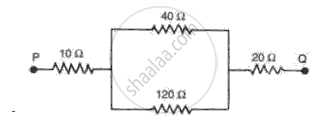
Find the effective resistance in the following circuit diagrams (Fig.):
An electric kettle has a heating element which is rated at 2 kW when connected to a 250 V electric supply. Calculate the
(a) Current which flows in the element when it is connected to a 250 V supply,
(b) Resistance of the filament,
(c) Heat produced in 1 minute by the element,
(d) Cost of running the kettle for 10 minutes a day for 30 days of the month, at the rate of Rs. 3.00 per unit.
Explain with the help of a diagram how does 'short circuiting' occur in an electric kettle.
Tick (✓) the correct choice among the following :
There are 500 turns and 2000 turns in the primary and secondary coil of a
transformer respectively. If th e output voltage is 1000 V, how large is the
input voltage?
Three heaters each rated 250 W, 100 V are connected in parallel to a 100 V supply. Calculate :
The total current taken from the supply
An electric kettle is rated 2.5 kW, 250 V. Find the cost of running the kettle for two hours at Rs. 5.40 per unit.
Two electric bulbs rated 100 W; 220 V and 60 W; 220 V are connected in parallel to electric mains of 220 V. Find the current drawn by the bulbs from the mains.
One unit of electrical energy consumed is equal to 1000 kilowatt-hour.
Which of the following represents voltage?
