Advertisements
Advertisements
Question
Two lamps, one rated 40 W at 220 V and the other 60 W at 220 V, are connected in parallel to the electric supply at 220 V.
(a) Draw a circuit diagram to show the connections.
(b) Calculate the current drawn from the electric supply.
(c) Calculate the total energy consumed by the two lamps together when they operate for one hour.
Advertisements
Solution
(a) 220 V
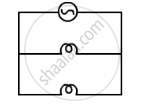
(b) Current drawn by the 40 W bulb, `I_1=P/V=40/200=0.18A`
Current drawn by the 60 W bulb, `I_2=P/V=60/200=0.27A`
Total current drawn, `I=I_1+I_2=0.18A+0.27A=0.45A`
(c) Total energy consumed, `E=sum(pxxt)=(40xx1)+(60xx1)=100wh=0.1"kwh""`
APPEARS IN
RELATED QUESTIONS
Define the unit of current.
If the current through a floodlamp is 5 A, what charge passed in 10 seconds?
(a) 0.5 C
(b) 2 C
(c) 5 C
(d) 50 C
An electric bulb of resistance 20 Ω and a resistance wire of 4 Ω are connected in series with a 6 V battery.
Draw the circuit diagram, and calculate:
(a) total resistance of the circuit.
(b) current through the circuit.
(c) potential difference across the electric bulb.
(d) potential difference across the resistance wire.
A p.d. of 6 V is applied to two resistors of 3 Ω and 6 Ω connected in parallel. Calculate:
(a) the combined resistance
(b) the current flowing in the main circuit
(c) the current flowing in the 3 Ω resistor.
V1, V2 and V3 are the p.ds. across the 1Ω, 2Ω and 3Ω resistors in the following diagram, and the current is 5 A.
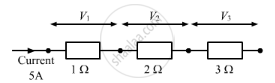
Which one of the columns (a) to (d) shows the correct values of V1, V2 and V3measured in volts?
`V_1` `V_2` `V_3`
(a) 1.0 2.0 3.0
(b) 5.0 10.0 15.0
(c) 5.0 2.5 1.6
(d) 4.0 4.0 2.0
You can given one hundred 1 Ω resistors. What is the smallest and largest resistance you can make in a circuit using these?
Name two effects produced by electric current.
State the S.I. unit of current.
The following table shows the current in Amperes and potential differences in Volts.
- Find the average resistance.
- What will be the nature of the graph between the current and potential difference? (Do not draw a graph.)
- Which law will the graph prove? Explain the law.
| V (volts) | I (amp) |
| 4 | 9 |
| 5 | 11.25 |
| 6 | 13.5 |
If a fuse contains a 5 A fuse wire and the voltage is 240 V, what is the maximum power (wattage) which may be taken from the circuit?
What would be the danger involved in replacing a blown fuse with the one which would carry a large current?
A current of 0.2 A flows through a wire whose ends are at a potential difference of 15 V. Calculate:
(i) The resistance of the wire, and
(ii) The heat energy produced in 1 minute.
Three heaters each rated 250 W, 100 V are connected in parallel to a 100 V supply of the energy supplied in kWh to the three heaters in 5 hours.
A bulb is connected to a battery of p.d. 4 V and internal resistance 2.5 Ω . A steady current of 0.5 A flows through the circuit. Calculate:
The resistance of the bulb
When an electric current is passed, electrons move from:
In metallic conductors, the charge carriers responsible for producing electric current are:
