Advertisements
Advertisements
Question
Two electric bulbs rated 100 W; 220 V and 60 W; 220 V are connected in parallel to electric mains of 220 V. Find the current drawn by the bulbs from the mains.
Advertisements
Solution
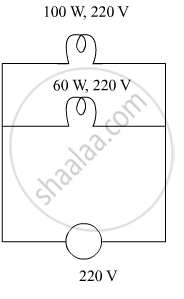
Firstly calculating the resistance of the electric bulbs,
P=`"V"^2/"R"`
⇒ `"R"="V"^2/"P"`
⇒ `"R"_1 =220^2/100 =484 Ω`
⇒ `"R"_2=220^2/60=2420/3 Ω`
`"R"_"eq" = ("R"_1"R"_2)/("R"_1+"R"_2)=(484xx(2420//3))/(484+(2420//3))=302.5Ω`
Total current drawn by the bulbs from the mains supply,
`"I"=220/302.5=0.73 "A"`
APPEARS IN
RELATED QUESTIONS
How many milliamperes as there in 1 ampere?
If the charge on an electron is 1.6 × 10⁻¹⁹ coulombs, how many electrons should pass through a conductor in 1 second to constitute 1 ampere current?
Define the following:
Super conductors
A charge of 80 C flows in a conductor for 2 minutes.
(a) Calculate the current flowing through the conductor.
(b) If the current through a heater is 4 A what charge must be passing in 8 seconds?
An electric bulb is marked '100 W, 250 V'. What information does this convey?
State whether the following statement is True or False:
The SI unit of charge is the coulomb.
Match the following:
| 1. | 1 mA | a. | series |
| 2. | 1 pA | b. | ohmmeter |
| 3. | Ammeter | c. | 10-6 ampere |
| 4. | Electrical resistivity | d. | 10-3 ampere |
Electric current flows through a circuit only when:
