Advertisements
Advertisements
प्रश्न
Two electric bulbs rated 100 W; 220 V and 60 W; 220 V are connected in parallel to electric mains of 220 V. Find the current drawn by the bulbs from the mains.
Advertisements
उत्तर
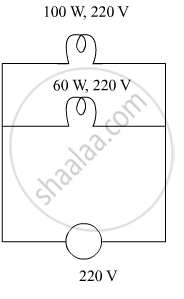
Firstly calculating the resistance of the electric bulbs,
P=`"V"^2/"R"`
⇒ `"R"="V"^2/"P"`
⇒ `"R"_1 =220^2/100 =484 Ω`
⇒ `"R"_2=220^2/60=2420/3 Ω`
`"R"_"eq" = ("R"_1"R"_2)/("R"_1+"R"_2)=(484xx(2420//3))/(484+(2420//3))=302.5Ω`
Total current drawn by the bulbs from the mains supply,
`"I"=220/302.5=0.73 "A"`
APPEARS IN
संबंधित प्रश्न
A car headlight bulb working on a 12 V car battery draws a current of 0.5 A. The resistance of the light bulb is:
A battery and three lamps are connected as shown:
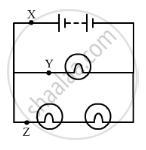
Which of the following statements about the currents at X, Y and Z is correct?
(a) The current at Z is greater than that at Y.
(b) The current at Y is greater than that at Z.
(c) The current at X equals the current at Y.
(d) The current at X equals the current at Z.
You can given one hundred 1 Ω resistors. What is the smallest and largest resistance you can make in a circuit using these?
For a heater rated at 4 kW and 220 V, calculate:
(a) the current,
(b) the resistance of the heater,
(c) the energy consumed in 2 hours, and
(d) the cost if 1 kWh is priced at Rs 4.60.
If the current passing through a conductor is doubled, what will be the change in heat produced
Electrical appliances have voltage and power ratings as listed below. Which
has the larger working resistance?
| Appliances | Voltage (V) | Power (W) |
| (a) Washing machine | 250 | 3000 |
| ( b) Television | 240 | 160 |
| (c)240 | 240 | 1500 |
| ( d) Hair curler | 250 | 20 |
| ( e) Car head lamp | 12 | 36 |
For current to flow, one needs art open circuit.
