Advertisements
Advertisements
प्रश्न
Two electric bulbs rated 100 W; 220 V and 60 W; 220 V are connected in parallel to electric mains of 220 V. Find the current drawn by the bulbs from the mains.
Advertisements
उत्तर
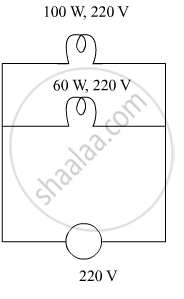
Firstly calculating the resistance of the electric bulbs,
P=`"V"^2/"R"`
⇒ `"R"="V"^2/"P"`
⇒ `"R"_1 =220^2/100 =484 Ω`
⇒ `"R"_2=220^2/60=2420/3 Ω`
`"R"_"eq" = ("R"_1"R"_2)/("R"_1+"R"_2)=(484xx(2420//3))/(484+(2420//3))=302.5Ω`
Total current drawn by the bulbs from the mains supply,
`"I"=220/302.5=0.73 "A"`
APPEARS IN
संबंधित प्रश्न
The work done in moving a unit charge across two points in an electric circuit is a measure of ______.
What actually travels through the wires when you switch on a light?
State the relation between work, charge and potential difference for an electric circuit.
Calculate the amount of energy transferred by a 10 A electric current flowing through a resistor of 5 o for 15 minutes.
Problems for practice:
If 3A current flows through a circuit, then convert the current in terms of a milliampere.
