Advertisements
Advertisements
प्रश्न
Draw a circuit diagram showing two lamps, one cell and a switch connected in series.
How can you change the brightness of the lamp?
Advertisements
उत्तर
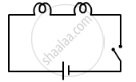
The brightness of the lamp can be changed by connecting the lamps in parallel.
APPEARS IN
संबंधित प्रश्न
How many milliamperes as there in 1 ampere?
Which of the two is connected in series : ammeter or voltmeter?
If the current through a floodlamp is 5 A, what charge passed in 10 seconds?
(a) 0.5 C
(b) 2 C
(c) 5 C
(d) 50 C
State the factors on which the strength of electric current flowing in a given conductor depends.
State the S.I. unit of current.
Find the potential difference required to pass a current of 0.2 A in a wire of resistance 20Ω
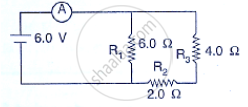
Three resistors of 6.0 𝛀, 2.0𝛀 and 4.0𝛀 are joined to an ammeter A and a cell of e.m.f. 6.0 V as
shown in fig 8.52 Calculate:
(a) the effective resistance of the circuit and
(b) the reading of ammeter.
Define the following:
Super conductors
A charge of 80 C flows in a conductor for 2 minutes.
(a) Calculate the current flowing through the conductor.
(b) If the current through a heater is 4 A what charge must be passing in 8 seconds?
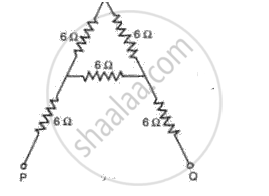
Find the effective resistance in the following circuit diagrams (Fig.):
Define the term kilowatt - hour and state its value in S.I. unit.
A bulb is connected to a battery of p.d. 4 V and internal resistance 2.5 Ω . A steady current of 0.5 A flows through the circuit. Calculate:
The total energy supplied by the battery in 10 minutes
A bulb is connected to a battery of p.d. 4 V and internal resistance 2.5 Ω . A steady current of 0.5 A flows through the circuit. Calculate:
The energy dissipated in the bulb in 10 minutes.
One unit of electrical energy consumed is equal to 1000 kilowatt-hour.
Problems for practice:
If 5A current flows through a circuit, then convert the current in terms of microampere?
Define the following:
Conventional current
Match the items in column-I to the items in column-II:
| Column - I | Column - II |
| (i) electric current | (a) volt |
| (ii) potential difference | (b) ohm meter |
| (iii) specific resistance | (c) watt |
| (iv) Electrical power | (d) joule |
| (v) electrical energy | (e) ampere |
In electrolytes such as salt solutions, the charge carriers are:
