Advertisements
Advertisements
प्रश्न
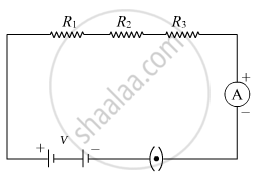
How will you infer with the help of an experiment that the same current flows through every part of the circuit containing three resistors R1, R2 and R3 in series connected to a battery of V volts?
Advertisements
उत्तर
Consider the given circuit in which a series combination of three resistors of resistances R1, R2 and R3 are shown to be connected to a battery of V volts. An ammeter is also shown to be connected in the circuit. It can be inferred that the current remains the same in the circuit by placing the ammeter at different points in the same circuit i.e. At any point just after R1, R2, and R3. It is observed that the value of the current observed in the ammeter comes to be the same.
APPEARS IN
संबंधित प्रश्न
Two conducting wires of the same material and of equal lengths and equal diameters are first connected in series and then parallel in a circuit across the same potential difference. The ratio of heat produced in series and parallel combinations would be:
Why are copper and aluminium wires usually employed for electricity transmission?
List the factors on which the resistance of a conductor in the shape of a wire depends.
What is meant by the "resistance of a conductor" ? Write the relation between resistance, potential difference and current.
Which has more resistance:
a thick piece of nichrome wire or a thin piece?
What will be the resistance of a metal wire of length 2 metres and area of cross-section 1.55 × 10⁻⁶ m2 if the resistivity of the metal be 2.8 × 10⁻⁸ Ω m?
Calculate the resistance of a copper wire 1.0 km long and 0.50 mm diameter if the resistivity of copper is 1.7 × 10⁻⁸ Ω m.
How does the resistance of a conductor depend on:
length of the conductor?
How does the resistance of a conductor depend on:
temperature of the conductor?
Use the data in the Table given below to answer the following –
Which material is the best conductor?
Table give below Electrical resistivity of some substances at 20°C
| Electrical resistivity of some substances at 20°C | ||
| − | Material | Resistivity (Ω m) |
| Conductors |
Silver | 1.60 × 10⁻⁸ |
| Copper | 1.62 × 10⁻⁸ | |
| Aluminium | 2.63 × 10⁻⁸ | |
| Tungsten | 5.20 × 10⁻⁸ | |
| Nickel | 6.84 × 10⁻⁸ | |
| Iron | 10.0 × 10⁻⁸ | |
| Chromium | 12.9 × 10⁻⁸ | |
| Mercury | 94.0 × 10⁻⁸ | |
| Manganese | 1.84 × 10⁻⁶ | |
| Alloys |
Constantan (alloy of Cu and Ni) |
49 × 10−6 |
| Manganin (alloy of Cu, Mn and Ni) |
44 × 10−6 | |
| Nichrome (alloy of Ni, Cr, Mn and Fe) |
100 × 10−6 | |
| Insulators | Glass | 1010 − 1014 |
| Hard rubber | 1013 − 1016 | |
| Ebonite | 1015 − 1017 | |
| Diamond | 1012 − 1013 | |
| Paper (dry) | 1012 | |
