Advertisements
Advertisements
Question
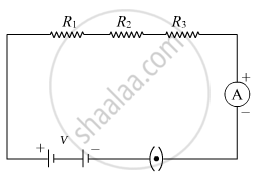
How will you infer with the help of an experiment that the same current flows through every part of the circuit containing three resistors R1, R2 and R3 in series connected to a battery of V volts?
Advertisements
Solution
Consider the given circuit in which a series combination of three resistors of resistances R1, R2 and R3 are shown to be connected to a battery of V volts. An ammeter is also shown to be connected in the circuit. It can be inferred that the current remains the same in the circuit by placing the ammeter at different points in the same circuit i.e. At any point just after R1, R2, and R3. It is observed that the value of the current observed in the ammeter comes to be the same.
APPEARS IN
RELATED QUESTIONS
What is (a) the highest, (b) the lowest total resistance that can be secured by combinations of four coils of resistance 4 Ω, 8 Ω, 12 Ω, 24 Ω?
A copper wire has diameter 0.5 mm and resistivity of 1.6 × 10⁻⁸Ω m. What will be the length of this wire to make its resistance 10 Ω? How much does the resistance change if the diameter is doubled?
Why are alloys commonly used in electrical heating devices? Give reason.
What is the general name of the substances having infinitely high electrical resistance?
What happens to the resistance as the conductor is made thinner?
What happens to the resistance as the conductor is made thicker?
Which among iron and mercury is a better conductor of electricity?
Which has more resistance:
a long piece of nichrome wire or a short one?
What would be the effect on the resistance of a metal wire of:
increasing its diameter?
How does the resistance of a wire change when:
its material is changed to one whose resistivity is three times?
