Advertisements
Advertisements
प्रश्न
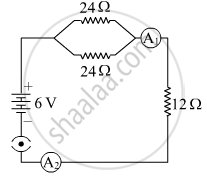
Study the following circuit and find out:
(i) Current in 12 Ω resistor.
(ii) The difference in the readings of A1 and A2, if any.
Advertisements
उत्तर

Firstly calculating the equivalent resistance in the circuit.
`"R"_"eq" =( 24xx24)/(24+24)+12=24Ω`
(i) The current through the 12 Ω resistor is given by:
`"I" = 6/24=1/4 "A"`
APPEARS IN
संबंधित प्रश्न
In which direction does conventional current flow around a circuit?
What happens to the other bulbs in a parallel circuit if one bulb blows off?
Match the pairs.
| ‘A’ Group | ‘B’ Group |
| 1. Free electrons | a. V/R |
| 2. Current | b. Increases the resistance in the circuit |
| 3. Resistivity | c. Weakly attached |
| 4. Resistances in series | d. VA/LI |
Find the effective resistance in the following circuit diagrams (Fig.):

60 joules of heat was dissipated in a resistor when 20 C flowed for 5 s. Calculate:
(a) P.d. across the resistor,
(b) Resistance of the resistor, and
(c) Average power dissipated in the resistor.
Explain with the help of a diagram how does 'short circuiting' occur in an electric kettle.
A current of 0.2 A flows through a wire whose ends are at a potential difference of 15 V. Calculate:
(i) The resistance of the wire, and
(ii) The heat energy produced in 1 minute.
An electric bulb is rated 250 W, 230 V.
- the energy consumed in one hour, and
- the time in which the bulb will consume 1.0 kWh energy when connected to 230 V mains.
Define an electric current.