Advertisements
Advertisements
Question
An electric kettle has a heating element which is rated at 2 kW when connected to a 250 V electric supply. Calculate the
(a) Current which flows in the element when it is connected to a 250 V supply,
(b) Resistance of the filament,
(c) Heat produced in 1 minute by the element,
(d) Cost of running the kettle for 10 minutes a day for 30 days of the month, at the rate of Rs. 3.00 per unit.
Advertisements
Solution
Given power P = 2k W = 2000 W, Voltage = 250 V
(a) Current I= `"P"/"V" = 2000/250 = 8 "A"`
(b) Resistance R = `"V"^2/"R" "t" = (250)^2/31.25 xx 60 = 1.2 xx 10^5 "Joules"`
(d)Energyconsumedperday=P x t=2 x `(10/60)` = 0.33 kWh
Energy consumed in 30 days= 0.33 x 30 = 10 kWh
Cost of running it @Rs3 per unit = 10 x 3 =Rs 30
APPEARS IN
RELATED QUESTIONS
What Makes an Electric Current Flow in a Wire?
In 10 s, charge of 25 C leaves a battery, and 200 J of energy are delivered to an outside circuit a result.
What current flows from the battery?
In the circuit shown below, the voltmeter reads 10 V.
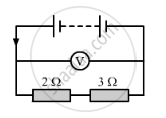
(a) What is the combined resistance?
(b) What current flows?
(c) What is the p.d. across 2 Ω resistor?
(d) What is the p.d. across 3 Ω resistor?
Ten bulbs are connected in a series circuit to a power supply line. Ten identical bulbs are connected in a parallel circuit to an identical power supply line.
(c) In which circuit, if one bulb blows out, all other will stop glowing?
Define the term resistivity.
A given wire of resistance 1 Ω is stretched to double its length. What will be its new resistance?
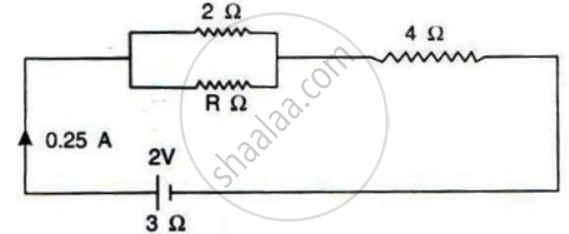
The following circuit diagram shows three resistors 2 Ω, 4 Ω and R Ω connected to a battery of e.m.f 2V and internal resistance 3 Ω. If the main current of 0.25 A flows through the circuit, find:
- the p.d. across the 4 Ω resistors,
- the p.d. across the internal resistance of the cell,
- the p.d. across the R Ω or 2 Ω resistors, and
- the value of R.
A bulb marked 12 V, 24 W operates on a 12 volt car battery for 20 minutes. Calculate:
(i) The current flowing through it, and
(ii) The energy liberated.
The number of electrons constituting a 1-coulomb charge is ______.
In electrolytes such as salt solutions, the charge carriers are:
