Advertisements
Advertisements
Question
Which of the following represents voltage?
Options
`("Work done")/("Current" xx "Time")`
Work done × Charge
`("Work done" xx "Time")/"Current"`
Work done × Charge × Time
Advertisements
Solution
`("Work done")/("Current" xx "Time")`
Explanation -
Potential difference (V) is defined as the ratio of work done (W) and charge (Q).
`"V" = "W"/"Q"`
Q = i × t
Charge is defined as
Q = i × t
where i = current
t = time
So,
`"V" = "W"/("i" xx "t")`
`"Voltage" = ("Work done")/("Current" xx "Time")`
APPEARS IN
RELATED QUESTIONS
Draw the electrical symbols of the following components and state its use:
Rheostat (variable resistance)
What is the unit of electric current?
V1, V2 and V3 are the p.ds. across the 1Ω, 2Ω and 3Ω resistors in the following diagram, and the current is 5 A.
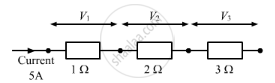
Which one of the columns (a) to (d) shows the correct values of V1, V2 and V3measured in volts?
`V_1` `V_2` `V_3`
(a) 1.0 2.0 3.0
(b) 5.0 10.0 15.0
(c) 5.0 2.5 1.6
(d) 4.0 4.0 2.0
How does the heat H produced by a current passing through a fixed resistance wire depend on magnitude of current I?
Name two devices which work on the heating effect of electric current.
State three factors on which the heat produced by an electric current depends. How does it depend on these factors?
Two resistors P and Q of the same material and length but of different thickness are connected in parallel to a battery. The cross- sectional area of P is twice that of Q. What is the ratio of
(a) The resistance of P to the resistance of Q?
(b) The current in P to the current in Q?
What is the function of a step-up transformer?
Electrical power P is given by the expression P = (Q × V) ÷ time
(a) What do the symbols Q and V represent?
(b) Express the power P in terms of current and resistance explaining the meanings of symbols used there in.
An electric iron is rated 750 W, 230 V. Calculate the electrical energy consumed by the press in 16 hours.
My mother was operating washing machine on Sunday morning. Suddenly, she saw a spark coming out of the electric board and the electric current in the house failed. An electrician was called to look into the matter. What should he have noticed.
In current electricity, a positive charge refers to ______.
Name any two devices, which are working on the heating effect of the electric current.
What is the SI unit for the current?
1020 electrons, each having a charge of 1.6 x 10⁻¹⁹ C, flows in a circuit V is 0.1s. What is the current in ampere?
Match the items in column-I to the items in column-II:
| Column - I | Column - II |
| (i) electric current | (a) volt |
| (ii) potential difference | (b) ohm meter |
| (iii) specific resistance | (c) watt |
| (iv) Electrical power | (d) joule |
| (v) electrical energy | (e) ampere |
Common sources of Direct Current (DC) are:
A charge of 20 C flows through a conductor in 4 s. The electric current through the conductor is:
