Advertisements
Advertisements
Question
If you were going to connect two light bulbs to one battery, would you use a series or a parallel arrangement? Why? Which arrangement takes more current from the battery?
Advertisements
Solution
Since every lightbulb in a parallel circuit receives the same voltage as the battery, I would choose to utilize a parallel arrangement. Additionally, if a flaw causes one light to stop glowing, the other bulb keeps glowing. This guarantees that even in the event of a single bulb failure, the circuit will continue to function. Because the parallel design has a lower equivalent resistance than a series arrangement, it pulls more current from the battery. Ohm's Law (I = V/R) states that a stronger current from the same voltage source is produced by a lower resistance.
APPEARS IN
RELATED QUESTIONS
Define the unit of current.
Compare how an ammeter and a voltmeter are connected in a circuit.
What is an Ammeter? How is It Connected in a Circuit? Draw a Diagram to Illustrate Your Answer.
In the circuit diagram given below, three resistors R1, R2, and R3 of 5 Ω, 10 Ω and 30 Ω, respectively are connected as shown
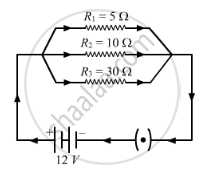
Calculate:
- current through each resistor.
- total current in the circuit.
- total resistance in the circuit.
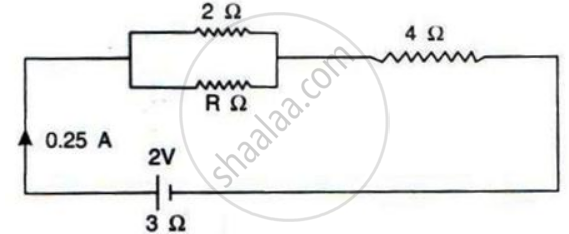
The following circuit diagram shows three resistors 2 Ω, 4 Ω and R Ω connected to a battery of e.m.f 2V and internal resistance 3 Ω. If the main current of 0.25 A flows through the circuit, find:
- the p.d. across the 4 Ω resistors,
- the p.d. across the internal resistance of the cell,
- the p.d. across the R Ω or 2 Ω resistors, and
- the value of R.
State the relation between work, charge and potential difference for an electric circuit.
A battery of e.m.f. 15 V and internal resistance 3 ohm is connected to two resistors of resistance 3 ohm and 6 ohm in series. Find:
(i) The current through the battery,
(ii) The p.d. between the terminals of the battery.
Tick(✓) the correct choice in the following:
When the length of a conductor is doubled the resistance of the conductor
will
Tick (✓) the correct choice among the following :
Which of the following changes would enable a millimeter to be used as a
direct current ammeter reading upto 1 A?
- What is meant by electric current?
- Name and define its unit.
- Which instrument is used to measure the electric current? How should it be connected in a circuit?
Which of the following represents voltage?
Electric current is defined as:
The RMS value of AC is defined as:
