Advertisements
Advertisements
Question
In 10 s, a charge of 25 C leaves a battery, and 200 J of energy are delivered to an outside circuit as a result.
- What is the p.d. across the battery?
- What current flows from the battery?
Advertisements
Solution
Given: Time (t) = 10 s
Charge (Q) = 25 C
Energy delivered is work done (W) = 200 J
a. Using the relation,
Potential difference = `"Work done"/"Charged moved"`
V = `W/Q`
V = `200/25`
V = 8 V
∴ So the p.d. across the battery is 8 volts.
b. Current = `"Charge"/"Time"`
I = `Q/t`
I = `25/10`
I = 2.5 A
∴ So, a current of 2.5 A flows from the battery.
APPEARS IN
RELATED QUESTIONS
Why are metals good conductors of electricity whereas glass is a bad conductor of electricity? Give reason?
Three 2 V cells are connected in series and used as a battery in a circuit.
How many joules of electrical energy does 1 C gain on passing through (i) one cell (ii) all three cells?
How many milliamperes as there in 1 ampere?
What Makes an Electric Current Flow in a Wire?
<p> Define the unit of electric current (or Define ampere).
You can given one hundred 1 Ω resistors. What is the smallest and largest resistance you can make in a circuit using these?
A wire of uniform thickness with a resistance of 27Ω is cut into three equal pieces and they are joined in parallel. Find the equivalent resistance of the parallel combination.
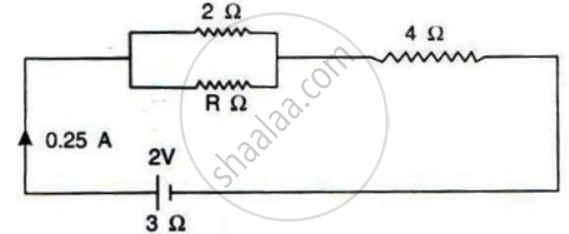
The following circuit diagram shows three resistors 2 Ω, 4 Ω and R Ω connected to a battery of e.m.f 2V and internal resistance 3 Ω. If the main current of 0.25 A flows through the circuit, find:
- the p.d. across the 4 Ω resistors,
- the p.d. across the internal resistance of the cell,
- the p.d. across the R Ω or 2 Ω resistors, and
- the value of R.
Two resistors P and Q of the same material and length but of different thickness are connected in parallel to a battery. The cross- sectional area of P is twice that of Q. What is the ratio of
(a) The resistance of P to the resistance of Q?
(b) The current in P to the current in Q?
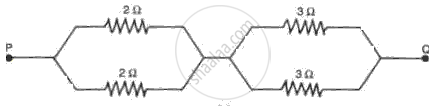
Find the effective resistance in the following circuit diagrams (Fig.):
A bulb is connected to a battery of p.d. 4 V and internal resistance 2.5 Ω . A steady current of 0.5 A flows through the circuit. Calculate:
The total energy supplied by the battery in 10 minutes
Fill in the blank :
1 mA = ............................. A.
What is meant by internal resistance of a cell?
One unit of electrical energy consumed is equal to 1000 kilowatt-hour.
Problems for practice:
If 3A current flows through a circuit, then convert the current in terms of a milliampere.
Find the odd one out.
Loudspeaker, Bar magnet/magnet, Electric motor, Microphone.
