Advertisements
Advertisements
Question
Three 2 V cells are connected in series and used as a battery in a circuit.
How many joules of electrical energy does 1 C gain on passing through (i) one cell (ii) all three cells?
Advertisements
Solution
(i) For one cell:
V = 2 V
Q = 1 C
And also:
Electrical energy gained = Work done
So using the relation, V = W/Q or W = V x Q
= 2 x 1 = 2 J
(ii) For three cells:
V = 6 V
Q = 1 C
So, W = V x Q = 6 x 1 = 6 J
So 2 joules and 6 joules of electrical energy is gained for the above two cases (i) one cell and (ii) all three cells, respectively.
RELATED QUESTIONS
Draw the electrical symbols of the following components and state its use:
Ammeter.
If the amount of electric charge passing through a conductor in 10 minutes is 300 C, the current flowing is:
(a) 30 A
(b) 0.3 A
(c) 0.5 A
(d) 5 A
Three resistors are connected as shown in the diagram.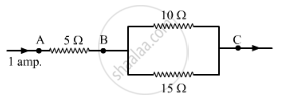
Through the resistor 5 ohm, a current of 1 ampere is flowing.
(i) What is the current through the other two resistors?
(ii) What is the p.d. across AB and across AC?
(iii) What is the total resistance
How do you think the brightness of two lamps arranged in parallel compares with the brightness of two lamps arranged in series (both arrangements having one cell)?
Two lamps, one rated 40 W at 220 V and the other 60 W at 220 V, are connected in parallel to the electric supply at 220 V.
(a) Draw a circuit diagram to show the connections.
(b) Calculate the current drawn from the electric supply.
(c) Calculate the total energy consumed by the two lamps together when they operate for one hour.
State the S.I. unit of current.
In the network shown in the following adjacent Figure, calculate the equivalent resistance between the points.
- A and B
- A and C

State the relation between work, charge and potential difference for an electric circuit.
Match the pairs.
| ‘A’ Group | ‘B’ Group |
| 1. Free electrons | a. V/R |
| 2. Current | b. Increases the resistance in the circuit |
| 3. Resistivity | c. Weakly attached |
| 4. Resistances in series | d. VA/LI |
What is international convention of colour coding in a cable?
Tick(✓) the correct choice in the following:
24 watt, 12 volt head lamp is fully lit by connecting it to a 12 volt
battery. The working resistance of the lamp is
State the condition when it is advantageous to connect cells in parallel.
What is the speed of electric current?
A charge of 400C flows through a conductor for 13 minutes and 20 seconds. Find the magnitude of the current flowing through the conductor.
In electrolytes, the ions carrying charge move toward:
In ionised gases (plasma), the charge carriers are:
The magnitude of Alternating Current (AC):
Electric current flows through a circuit only when:
