Advertisements
Advertisements
प्रश्न
Advertisements
उत्तर
Precautions while using electricity:
(i) One must use wires or cables of current carrying capacity higher than the current which can flow through the circuit while using all appliances.
(ii) An electrical appliance must never be operated (or touched) with wet hands.
संबंधित प्रश्न
What does an electric circuit mean?
Draw the electrical symbols of the following components and state its use:
Ammeter.
The atoms of copper contain electrons and the atoms of rubber also contain electrons. Then why does copper conduct electricity but rubber does not conduct electricity?
Which particles constitute the electric current in a metallic conductor?
If 20 C of charge pass a point in a circuit in 1 s, what current is flowing?
The circuit diagram given below shows the combination of three resistors R1, R2 and R3:
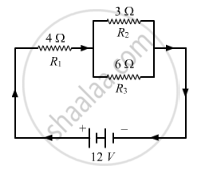
Find :
(i) total resistance of the circuit.
(ii) total current flowing in the circuit.
(iii) the potential difference across R1.
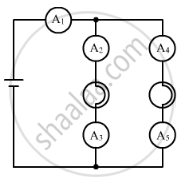
If the lamps are both the same in the figure given below and if A1 reads 0.50 A, what do A2, A3, A4 and A5 read?
What happens to the other bulbs in a parallel circuit if one bulb blows off?
Define the term resistivity.
A wire of length 5 m has a resistance of 2.0 Ω calculate:
(a) the resistance of wire of length 1 m
(b) the equivalent resistance if two such wires each of length 2 m are joined in parallel.
(c) the resistance of 1 m length of wire of same material but of half diameter.
The following table shows the current in Amperes and potential differences in Volts.
- Find the average resistance.
- What will be the nature of the graph between the current and potential difference? (Do not draw a graph.)
- Which law will the graph prove? Explain the law.
| V (volts) | I (amp) |
| 4 | 9 |
| 5 | 11.25 |
| 6 | 13.5 |
Tick(✓) the correct choice in the following:
Which of the following quantities has the same value for all electrical
appliances connected to the ring main circuit in a house?
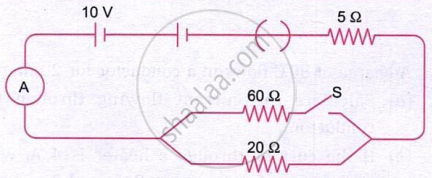
In the circuit shown in fig., find the reading of the ammeter A when the switch S is opened.
A current of 0.2 A flows through a wire whose ends are at a potential difference of 15 V. Calculate:
(i) The resistance of the wire, and
(ii) The heat energy produced in 1 minute.
A bulb is connected to a battery of p.d. 4 V and internal resistance 2.5 Ω . A steady current of 0.5 A flows through the circuit. Calculate:
The resistance of the bulb
Explain, why the potential difference across the terminals of a cell is more when the cell is not in use than it is when the cell is being used.
State the condition when it is advantageous to connect cells in series.
State the conditions for the flow of charge in a circuit from one point to the other.
True or False – If False give the correct answer
The representation of the electric current is A
One unit of electrical energy consumed is equal to 1000 kilowatt-hour.
Calculate the current in a wire if a charge of 1500 coulomb flows through it in 5 minutes.
The SI unit of electric current is:
By convention, the direction of electric current in the external circuit is taken as:
Common sources of Direct Current (DC) are:
