Advertisements
Advertisements
प्रश्न
Advertisements
उत्तर
Precautions while using electricity:
(i) One must use wires or cables of current carrying capacity higher than the current which can flow through the circuit while using all appliances.
(ii) An electrical appliance must never be operated (or touched) with wet hands.
संबंधित प्रश्न
Choose the correct alternative and rewrite the following sentence.
When the resistance of a conductor increases, the current will ________ increase.
In 10 s, a charge of 25 C leaves a battery, and 200 J of energy are delivered to an outside circuit as a result.
- What is the p.d. across the battery?
- What current flows from the battery?
You can given one hundred 1 Ω resistors. What is the smallest and largest resistance you can make in a circuit using these?
What happens to the other bulbs in a series circuit if one bulb blows off?
In the network shown in the following adjacent Figure, calculate the equivalent resistance between the points.
- A and B
- A and C

If a charge of 420 C flows through a conducting wire in 5 minutes what is the value of the current?
A 720 W heater operates from a 220 V line voltage. Calculate:
(a) The electrical energy consumed by the heater in 3 h.
(b) The cost of electrical energy consumption at the rate of 60 paise per kWh.
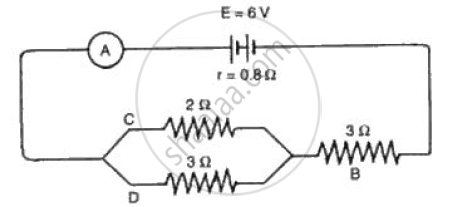
The circuit diagram (Fig.) shows a battery of e.m.f. 6 volts and internal
resistance of 0.8 Ω oonnected in series. Find the
(a) Current reoorded by the ammeter,
(b) P.d. across the terminals of the resistor B,
( c) Current passing through each of the resistors B, C and D, and
( d) P.d. across the terminals of the battery.
60 joules of heat was dissipated in a resistor when 20 C flowed for 5 s. Calculate:
(a) P.d. across the resistor,
(b) Resistance of the resistor, and
(c) Average power dissipated in the resistor.
A wire is passed through a piece of cardboard as shown in fig .. An electric current flows vertically down the wire and then flows back up. The two sections of the write are observed to repel each other.
(a) Wi th the aid of a diagram, describe how you would plot the magnetic field lines on the card .
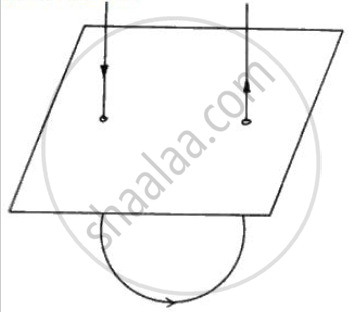
(b) Sketch the magnetic field patterns around both the sections of the wire. Use your sketch to explain why the two sections repel each other.
(c) The repulsive force between the two sections is small. What changes could be made to increase it?
Complete the following:
1 kWh = _________ J
A bulb marked 12 V, 24 W operates on a 12 V battery for 20 minutes. Calculate:
- The current flowing through it, and
- The energy consumed.
Explain, why the potential difference across the terminals of a cell is more when the cell is not in use than it is when the cell is being used.
State expression for Cells connected in series.
State the condition when it is advantageous to connect cells in parallel.
Which part of an electrical appliance is earthed?
Three resistances, of which two are equal when connected in series have an effective resistance of 30 ohms. When the three resistances are connected in parallel, the effective resistances is 3 ohms. Find the values of the individual resistances.
MCB is used to protect household electrical appliances.
Which of the following represents voltage?
Find the odd one out.
Loudspeaker, Bar magnet/magnet, Electric motor, Microphone.
A continuous and closed path of an electric current is called:
The value used for practical measurement of Alternating Current is the:
