Advertisements
Online Mock Tests
Chapters
2: Refraction of Light
3: The Human Eyes And The Colorful World
4: Electricity
▶ 5: Magnetic Effects of Electric Current
![Lakhmir Singh solutions for फिज़िक्स पार्ट १ [इंग्रजी] इयत्ता १० chapter 5 - Magnetic Effects of Electric Current - Shaalaa.com](/images/physics-part-1-english-class-10_6:5e8f817651d047a288d517e10b532fb7.jpg "Lakhmir Singh solutions for फिज़िक्स पार्ट १ [इंग्रजी] इयत्ता १० chapter 5 - Magnetic Effects of Electric Current")
Advertisements
Solutions for Chapter 5: Magnetic Effects of Electric Current
Below listed, you can find solutions for Chapter 5 of CBSE, Karnataka Board Lakhmir Singh for फिज़िक्स पार्ट १ [इंग्रजी] इयत्ता १०.
Lakhmir Singh solutions for फिज़िक्स पार्ट १ [इंग्रजी] इयत्ता १० 5 Magnetic Effects of Electric Current Exercise 1 [Pages 275 - 277]
Very Short Answer Type Questions
Write any three properties of magnetic lines of force.
What are the two ways in which you can trace the magnetic field pattern of a bar magnet?
You are given the magnetic field pattern of a magnet. How will you find out from it where the magnetic field is the strongest?
State whether the following statement is true of false:
The axis of earth's imaginary magnet and the geographical axis coincide with each other.
Why does a compass needle get deflected when brought near a bar magnet?
Where do the manufactures use a magnetic strip in the refrigerator? Why is this magnetic strip used?
Fill in the following blank with suitable words:
Magnetic field lines leave the .......... pole of a bar magnet and enter at its .......... pole.
Fill in the following blank with suitable words:
The earth's magnetic field is rather like that of a .......... magnet with its .......... pole in the northern hemisphere.
Short Answer Type Questions
Draw a diagram to show the magnetic field lines around a bar magnet.
What is a magnetic field?
How is the direction of a magnetic field at a point determined?
Explain why, two magnetic field lines of not intersect each other.
When an electric current is passed through any wire, a magnetic field is produced around it. Then why an electric iron connecting cable does not attract nearby iron objects when electric current switched on through it?
Long Answer Type Questions
Define magnetic field lines.
Describe an activity to draw a magnetic field line outside a bar magnet from one pole to another pole.
Explain why, a freely suspended magnet always points in the north-south direction.
Multiple Choice Questions (MCQs)
A strong bar magnet is placed vertically above a horizontal wooden board. The magnetic lines of force will be:
(a) only in horizontal plane around the magnet
(b) only in vertical plane around the magnet
(c) in horizontal as well as in vertical planes around the magnet
(d) in all the planes around the magnet
The magnetic field lines produced by a bar magnet:
(a) originate from the south pole and end at its north pole
(b) originate from the north pole and end at its east pole
(c) originate from the north pole and end at its south pole
(d) originate from the south pole and end at its west pole
Which of the following is not attracted by a magnet:
steel
cobalt
brass
nickel
The magnetic field lines:
(a) intersect at right angles to one another
(b) interest at an angle 45° to each another
(c) do not cross one another
(d) cross at an angle of 60° to one anotherv
The north pole of Earth’s magnet is in the ____________.
Geographical South
Geographical East
Geographical West
Geographical North
The axis of earth’s magnetic field is inclined with the geographical axis at an angle of about ______.
5°
15°
25°
35°
The shape of the earth's magnetic field resembles that of an imaginary:
(a) U-shaped magnet
(b) Straight conductor carrying current
(c) Current-carrying circular coil
(d) Bar magnet
A magnet attracts:
plastics
any metal
aluminium
iron and steel
A plotting compass is placed near the south pole of a bar magnet. The pointer of plotting compass will:
point away form the south pole
point parallel to the south pole
point towards the south pole
point at right angles to the south pole
The metallic pointer of a plotting compass gets deflected only when it is placed near a bar magnet because the pointer has:
electromagnetism
permanent magnetism
induced magnetism
ferromagnetism
Which of the following statements is incorrect regarding magnetic field lines?
(a) The direction of magnetic field at a point is taken to be the direction in which the north pole a magnetic compass needle points.
(b) Magnetic field lines are closed curves.
(c) If magnetic field lines are parallel and equidistant, they represent zero field strength.
(d) Relative strength of magnetic field is shown by the degree of closeness of the field lines.
Questions Based on High Order Thinking Skills (HOTS)/Case Based Questions
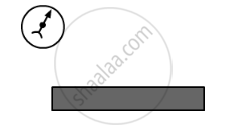
Copy the figure below which shows a plotting compass and a magnet. Label the N pole of the magnet and draw field line on which the compass lines
- The diagram shows a bar magnet surrounded by four plotting compasses. Copy the diagram and mark in it the direction of the compass needle for each of the cases B, C and D.
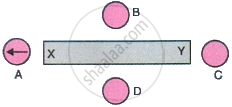
- Which is the north pole, X or Y?
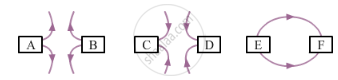
The three diagrams in the following figure show the lines of force (field lines) between the poles of two magnets. Identify the poles A, B, C, D, E and F.
The figure given below shows the magnetic field between two magnets:
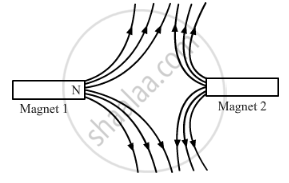
Copy the diagram and label theother poles of the magnets.
Which is the weaker magnet?
Lakhmir Singh solutions for फिज़िक्स पार्ट १ [इंग्रजी] इयत्ता १० 5 Magnetic Effects of Electric Current Exercise 2 [Pages 285 - 288]
Very Short Answer Type Questions
Which effect of current can be utilised in detecting a current carrying wire concealed in a wall?
What concealed do you get from the observation that a current-carrying wire deflects a compass needle placed near it?
Name the scientist who discovered the magnetic effect of current.
State qualitatively the effect of inserting an iron core into a current-carrying solenoid.
Name the rule for finding the direction of magnetic field produced by a straight current-carrying conductor.
State the form of magnetic field lines around a straight current-carrying conductor.
What is the other name of Maxwell's right-hand thumb rule?
State whether the following statement is true or false:
The magnetic field inside a long circular coil carrying current well be parallel straight lines.
What is the shape of a current-carrying conductor whose magnetic field pattern resembles that of a bar magnet?
State three ways in which the strength of an electromagnet can be increased.
Fill in the following blank with suitable words:
The lines of ........... round a straight current-carrying conductor are in the shape of ...........
Fill in the following blank with suitable words:
For a current-carrying solenoid, the magnetic field is like that of a ...........
Fill in the following blank with suitable words:
The magnetic effect of a coil can be increased by increasing the number of ........... increasing the ........... or inserting an ........... core.
Fill in the following blank with suitable words:
If a coil is viewed from one end and the current flows in an anticlockwise direction, then this end is a ........... pole.
Fill in the following blank with suitable words:
If a coil is viewed from one end, and the current flows in a clockwise direction, then this end is a ........... pole.
Short Answer Type Questions
Describe how you will locate a current-carrying wire concealed in a wall.
Describe some experiment to show that the magnetic field is associated with an electric current.
Draw a sketch to show the magnetic lines of force due to a current-carrying straight conductor.
Name and state the rule to determine the direction of magnetic field around a straight current-carrying conductor.
State and explain Maxwell's right-hand thumb rule.
What is Maxwell's corkscrew rule? For what purpose is if used?
Draw the magnetic lines of force due to a circular wire carrying current.
What are the various ways in which the strength of magnetic field produced by a current-carrying circular coil can be increased?
State and explain the clock-face rule for determining the polarities of a circular wire carrying current.
Name any two factors on which the strength of magnetic field produced by a current-carrying solenoid depends. How does it depend on these factors?
Draw a circuit diagram to show how a soft iron piece can be transformed into an electromagnet.
Describe how an electromagnet could be used to separate copper from iron in a scrap yard.
How does an electromagnet differ forma permanent magnet?
Name two devices in which electromagnets are used and two devices where permanent magnets are used.
Long Answer Type Questions
What is a solenoid?
Draw a sketch to show the magnetic field pattern produced by a currentcarrying solenoid.
Name the type of magnet with which the magnetic field pattern of a current-carrying solenoid resembles.
What is the shape of field lines inside a current-carrying solenoid? What does the pattern of field lines inside a current-carrying solenoid indicate?
List three ways in which the magnetic field strength of a current-carrying solenoid can be increased?
What type of core should be put inside a current-carrying solenoid to make an electromagnet?
What is an electromagnet? Describe the construction and working of an electromagnet with the help of a labelled diagram.
Explain why, an electromagnet is called a temporary magnet.
Explain why, the core of an electromagnet should be of soft iron and not of steel.
State the factors on which the strength of an electromagnet depends. How does it depend on these factors?
Write some of the important uses of electromagnets.
Multiple Choice Questions (MCQS)
The strength of the magnetic field between the poles of an electromagnet would be unchanged if ______.
current in the electromagnet winding were doubled.
direction of current in electromagnet winding were reversed.
distance between the poles of electromagnet were doubled.
material of the core of electromagnet were changed.
The diagram given below represents magnetic field caused by a current-carrying conductor which is:

(a) a long straight wire
(b) a circular coil
(c) a solenoid
(d) a short straight wire
The magnetic field inside a long straight solenoid carrying current ______.
is zero
decreases as we move towards its end.
increases as we move towards its end.
is same at all points.
Which of the following correctly describes the magnetic field near a long straight wire?
The field consists of straight lines perpendicular to the wire
The field consists of straight lines parallel to the wire
The field consists of radial lines originating from the wire
The field consists of concentric circles centred on the wire
The north-south polarities of an electromagnet can be found easily by using:
(a) Fleming's right-hand rule
(b) Fleming's left-hand rule
(c) Clock face rule
(d) Left-hand thumb rule
The direction of current in the coil at one end of an electromagnet is clockwise. This end of the electromagnet will be:
(a) north pole
(b) east pole
(c) south pole
(d) west pole
If the direction of electric current in a solenoid when viewed from a particular end is anticlockwise, then this end of solenoid will be:
(a) west pole
(b) south pole
(c) north pole
(d) east pole
The most suitable material for making the core of an electromagnet is:
(a) soft iron
(b) brass
(c) aluminium
(d) steel
The magnetic effect of current was discovered by:
(a) Maxwell
(b) Fleming
(c) Oersted
(d) Faraday
A soft iron bar is inserted inside a current-carrying solenoid. The magnetic field inside the solenoid:
(a) will decrease
(b) will increase
(c) will become zero
(d) will remain the same
The magnetic field lines in the middle of the current-carrying solenoid are?
(a) circles
(b) spirals
(c) parallel to the axis of the tube
(d) perpendicular to the axis of the tube
The front face of a circular wire carrying current behaves like a north pole. The direction of current in this face of circular wire is:
(a) clockwise
(b) downwards
(c) anticlockwise
(d) upwards
The back face of a circular loop of wire is found to be south magnetic pole. The direction of current in this face of the circular loop of wire will be:
(a) towards south
(b) clockwise
(c) anticlockwise
(d) towards north
Questions Based on High Order Thinking Skills (HOTS)/Case Based Questions
In the straight wire A, current is flowing in the vertically downwards direction whereas in wire B the current is flowing in the vertically upward direction. What is the direction of magnetic field:
(a) in wire A?
(b) in wire B?
Name the rule which you have used to get the answer.
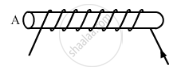
The figure shows a solenoid wound on a core of soft iron. Will the end A be a N pole or S pole when the current flows in the direction shown?
A current-carrying straight wire is held in exactly vertical position. If the current passes through this wire in the vertically upward direction, what is the direction of magnetic field produced by it? Name the rule used to find the direction of magnetic field.
For the coil in the diagram below, when the switch is pressed:
(a) what is the polarity of end A?
(b) which way will the compass point then?

A current flows downwards in a wire that passes vertically through a table top. Will the magnetic field lines around it go clockwise or anticlockwise when viewed from above the table?
The direction of current flowing in the coil of an electromagnet at its two ends X and Y are as shown below:
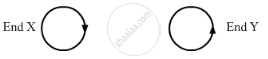
What is the polarity of end X?
What is the polarity of end Y?
Name and state the rule which you have used to determine the polarities.
The magnetic field associated with a current-carrying straight conductor is in anticlockwise direction. If the conductor was held along the east-west direction, what will be the direction of current through it? Name and state the rule applied to determine the direction of current?
A current-carrying conductor is held in exactly vertical direction. In order to produce a clockwise magnetic field around the conductor, the current should passed in the conductor:
(a) from top towards bottom
(b) from left towards right
(c) from bottom towards top
(d) from right towards left
A thick wire is hanging form a wooden table. An anticlockwise magnetic field is to be produced around the wire by passing current through this wire by using a battery. Which terminal of the battery should be connected to the:
(a) top end of wire?
(b) bottom end of wire?
Give reason for your choice.
Lakhmir Singh solutions for फिज़िक्स पार्ट १ [इंग्रजी] इयत्ता १० 5 Magnetic Effects of Electric Current Exercise 3 [Page 289]
Very Short Answer Type Questions
What produces magnetism in the human body?
Name one medical technique which is based on magnetism produced in human body. For what purpose is this technique used?
Name two human body organs where magnetism produced is significant.
What is the full form of MRI?
Name the technique by which doctors can produce pictures showing insides of the human body.
Name one technique which can detect cancerous tissue inside the body of a person.
Lakhmir Singh solutions for फिज़िक्स पार्ट १ [इंग्रजी] इयत्ता १० 5 Magnetic Effects of Electric Current Exercise 4 [Pages 293 - 295]
Very Short Answer Type Questions
What happens when a current-carrying conductor is placed in a magnetic field?
When is the force experienced by a current-carrying conductor placed in a magnetic field largest?
In a statement of Fleming's left-hand rule, what do the following represent?
(a) direction of centre finger.
(b) direction of forefinger.
(c) direction of thumb.
For Fleming's left-hand rule, write down the three things that are 90° to each other, and next to each one write down the finger or thumb that represents it.
Fill in the following blank with suitable words:
Fleming's Rule for the motor effect uses the .......... hand.
Short Answer Type Questions
A current-carrying conductor is placed perpendicularly in a magnetic field. Name the rule which can be used to find the direction of force acting on the conductor.
State two ways to increase the force on a current-carrying conductor in a magnetic held.
State Fleming’s left-hand rule.
In a statement of Fleming’s left-hand rule, the direction of which finger/thumb represents?
Direction of current
In a statement of Fleming’s left-hand rule, the direction of which finger/thumb represents?
Direction of force (or motion)
In a statement of Fleming’s left-hand rule, the direction of which finger/thumb represents?
Direction of force (or motion)
- Draw a labelled diagram of the left-hand as per Fleming’s left-hand rule for the direction of force acting on a current carrying conductor placed in a magnetic field.
- In the above diagram, write the terms: Current, Magnetic field and Force on the appropriate fingers/ thumb.
Multiple Choice Questions (MCQs)
An electron beam enters a magnetic field at right angles to it as shown in the Figure.
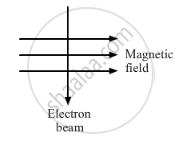
The direction of force acting on the electron beam will be:
to the left
to the right
into the page
out of the page
The force experienced by a current-carrying conductor placed in a magnetic field is the largest when the angle between the conductor and the magnetic field is:
45°
60°
90°
180°
The force exerted on a current-carrying wire placed in a magnetic field is zero when the angle between the wire and the direction of magnetic field is:
45°
60°
90°
180°
A current flows in a wire running between the S and N poles of a magnet lying horizontally as shown in Figure below:
The force on the wire due to the magnet is directed:
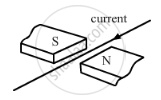
fron N to S
from S to N
vertically downwards
vertically upwards
A magnetic field exerts no force on:
an electrical charge moving perpendicular to its direction
an unmagnetised iron bar
a stationary electric charge
a magnet
A horizontal wire carries a current as shown in Figure below between magnetic poles N and S:
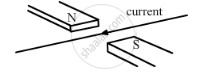
Is the direction of the force on the wire due to the magnet:
(a) in the direction the current
(b) vertically downwards
(c) opposite to the current direction
(d) vertically upwards
Questions Based on High Order Thinking Skills (HOTS)/Case Based Questions
Which way does the wire in the diagram below tend to move?
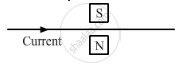
If the current in a wire is flowing in the vertically downward direction and a magnetic field is applied from west to east, what is the direction of force in the wire?
Which way does the wire in the diagram below tend to move?
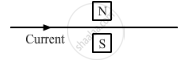
What is the force on a current-carrying wire that is parallel to a magnetic field? Give reason for your answer.
A charged particle enters at right angles into a uniform magnetic field as shown:
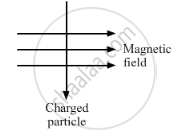
What should be the nature of charge on the particle if it begins to move in a direction pointing vertically our of the page due to its interaction with the magnetic field?
Lakhmir Singh solutions for फिज़िक्स पार्ट १ [इंग्रजी] इयत्ता १० 5 Magnetic Effects of Electric Current Exercise 5 [Page 296]
What is the difference between alternating current and direct current?
What type of current is given by a dry cell?
What type of current is given by a power house generator?
What do you understand by the term ‘direct current’?
What do you understand by the term ‘alternating current’?
Name some sources of direct current.
Name some sources of alternating current.
State an important advantage of alternating current over direct current.
What is the frequency of A.C. supply in India?
The frequency of direct current (d.c.) is:
(a) 0 Hz
(b) 50 Hz
(c) 60 Hz
(d) 100 H
The frequency of alternating current (a.c.) supply in India is ______.
0 Hz
50 Hz
60 Hz
100 Hz
A portable radio has a built-in transformer so that it can work from the mains instead of batteries. Is this a step-up or step-down transformer?
Lakhmir Singh solutions for फिज़िक्स पार्ट १ [इंग्रजी] इयत्ता १० 5 Magnetic Effects of Electric Current Exercise 6 [Pages 305 - 308]
Very Short Answer Type Questions
What name is given to the device which automatically cuts off the electricity supply during short-circuiting in household wiring?
What is the usual capacity of an electric fuse used (i) in the lighting circuit
What is the usual capacity of an electric fuse used in the power circuit, of a small house?
Give the symbol of an electric fuse used in circuit diagrams.
State whether the following statement are true of false:
A wire with a green insulation is usually the live wire.
State whether the following statement are true of false:
A miniature circuit breaker (MCB) works on the heating effect of current.
Along with live wire and neutral wire, a third wire is also used in domestic electric wiring. What name is given to this third wire?
List the colours of the three wires in the cable connected to the plug of an electric iron.
What is the electric potential of the wire in a mains supply cable?
If fuse of 250 mA, 500 mA, 1 A, 5 A and 10 A were available, which one would be the most suitable for protecting an amplifier rated at 240 V, 180 W?
When does an electric short circuit occur?
In which wire in a A.C. housing circuit is the switch introduced to operate the lights?
In household circuits, is a fuse wire connected in series or in parallel?
Usually three insulated wires of different colours are used in an electrical appliance. Name the three colours.
What is the usual colour of the insulation of:
Live wire
What is the usual colour of the insulation of:
Neutrral wire
What is the colour code for the insulation on the earth wire?
What is the main propose of earthing an electrical appliance?
Give two reasons why different electrical appliances in a domestics circuit are connected in parallel.
How should the electric lamps in a building be connected so that the switching on or off in a room has no effect on other lamps in the same building?
Fill in the following blank with suitable words:
A fuse should always be places in the ........... wire of a mains circuit.
The earth wire should be connected to the ______ of an appliance.
Short Answer Type Questions
Of what substance is the fuse wire made? Why?
Explain why, a copper wire cannot be used as a fuse wire.
What type of electric fuse is used in electrical appliances like car stereos? Explain with the help of a labelled diagram.
Distinguish between the terms ‘overloading’ and ‘short-circuiting’ as used in domestic circuits.
When does a fuse cut off current? How does it do it?
What is the maximum number of 60 W bulbs that can be run from the mains supply of 220 volts if you do not want to overload a 5 A fuse?
Explain the importance of using in a household electric circuit fuse wire.
Explain the importance of using in a household electric circuit earthing wire.
- An electric iron is rated at 230 V, 750 W. Calculate
- the maximum current, and
- the number of units of electricity it would use in 30 minutes.
- Which of the following fuse ratings would be suitable for this electric iron?
1 A, 3 A, 5 A, 13 A
What is the function of an earth wire?
Why is an earth wire necessary to earth the metallic bodies of electrical appliances?
- What current is taken by a 3 kW electric geyser working on 240 V mains?
- What size fuse should be used in the geyser circuit?
Why are fuses fitted in the fuse box of a domestic electricity supply?
Name the device used these days in place of electric fuses in electrical circuits.
Draw a labelled diagram to show the domestic electric wiring from an electric pole to a room. Give the wiring for a bulb and a three-pin socket only.
State two hazards associated with the use of electricity.
What will you do if you see a person coming in contact with a live wire?
Explain why, electric switches should not be operated with wet hands.
Multiple Choice Questions (MCQs)
At the time of short circuit, the current in the circuit ______.
reduces substantially
does not change
increases heavily
vary continuously
A 1.25 kW heater works on a 220 V mains supply. What current rating would a suitable fuse have?
2 A
5 A
10 A
13 A
The maximum number of 40 W tube-lights connected in parallel which can safely be run from a 240 V supply with a 5 A fuse is ______.
5
15
20
30
In normal use, a current of 3.5 A flows through a hair dryer. Choose a suitable fuse from the following:
3 A
5 A
10 A
30 A
Which one of the following statements is not true?
In a house circuit, lamps are used in parallel.
Switches, fuses and circuit breakers should be placed in the neutral wire.
An electric iron has its earth wire connected to the metal case to prevent the user receiving a shock.
When connecting a three-core cable to a 13 A three-pin plug, the red wire goes to the live pin.
A car headlamp of 48 W works on the car battery of 12 V. The correct fuse for the circuit of this car headlamp will be ______.
5 A
10 A
3 A
13 A
A 3-pin mains plug is fitted to the cable for a 1 kW electric kettle to be used on a 250 V a.c. supply. Which of the following statement is not correct?
The fuse should be fitted in the live wire.
A 13 A fuse is the most appropriate value to use.
The neutral wire is coloured black.
The green wire should be connected to the earth pin.
A TV set consumes an electric power of 230 watts and runs on 230 volts mains supply. The correct fuse for this TV set is ______.
5 A
3 A
1 A
2 A
Circuit Breaker Device which can be used in place of fuse in domestic electric wiring is called ______.
CBD
DCB
MCD
MCB
An MCB which cuts off the electricity supply in case of short-circuiting works on the ______.
chemical effect of current.
charging effect of current.
magnetic effect of current.
electroplating effect of current.
Questions Based on High Order Thinking Skills (HOTS)/Case Based Questions
An air-conditioner of 3.2 kW power rating is connected to a domestic electric circuit having a current rating of 10 A. The voltage of power supply is 220 V. What will happen when this air-conditioner is switched on? Explain your answer.
Three appliances are connected in parallel to the same source which provides a voltage of 220 V. A fuse connected to the source will blow if the current from the source exceeds 10 A. If the three appliances are rated at 60 W, 500 W and 1200 W at 220 V, will the fuse blow?
A vacuum cleaner draws a current of 2 A from the mains supply.
- What is the appropriate value of the fuse to be fitted in its circuit?
- What will happen if a 13 A fuse is fitted in its circuit?
Which of the following circuits will still be dangerous even if the fuse blows off and electric iron stops working during a short circuit?
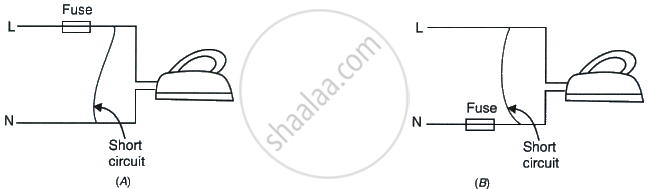
An electric kettle rated as 1200 W at 220 V and a toaster rated at 1000 W at 220 V are both connected in parallel to a source of 220 V. If the fuse connected to the source blows when the current exceeds 9.0 A, can both appliances be used at the same time? Illustrate your answer with calculations.
What is the main difference in the wiring of an electric bulb and a socket for using an electric iron in a domestic electric circuit? What is the reason for this difference?
Explain why, it is more dangerous to touch the live wire of a mains supply rather than the neutral wire.
Why is it safe for birds to sit on naked power lines fixed atop tall electric poles?
A domestic lighting circuit has a fuse of 5 A. If the mains supply is at 230 V, calculate the maximum number of 36 W tube-lights that can be safely used in this circuit.
Lakhmir Singh solutions for फिज़िक्स पार्ट १ [इंग्रजी] इयत्ता १० 5 Magnetic Effects of Electric Current Exercise 7 [Page 308]
Questions Based on Assertion-Reason
In the following questions, two statements are given-one labelled Assertion (A) and the other labelled Reason (R): Select the correct answer to these questions from the options given below:
Assertion (A): A fuse wire is always connected in series with the mainline.
Reason (R): If a current larger than the specified value flows through the circuit, fuse wire gets heated too much, melts and breaks the circuit.
Both A and R are true and R is correct explanation of the assertion.
Both A and R are true but R is not the correct explanation of the assertion.
A is true but R is false.
A is false but R is true.
Assertion (A): An MCB works on the magnetic effect of current.
Reason (R): During short-circuiting, when too much current flows through the circuit, the thin fuse wire in MCB gets heated, melts and breaks the circuit so as to prevent an electrical fire.
Both A and R are true and R is correct explanation of the assertion.
Both A and R are true but R is not the correct explanation of the assertion.
A is true but R is false.
A is false but R is true.
Assertion (A): A current-carrying wire concealed in a wall can be located by using a plotting compass.
Reason (R): The plotting compass contains a tiny pivoted magnet.
Both A and R are true and R is correct explanation of the assertion.
Both A and R are true but R is not the correct explanation of the assertion.
A is true but R is false.
A is false but R is true.
Assertion (A): An electromagnet is not a permanent magnet.
Reason (R): The magnetism of an electromagnet is only for the duration of current passing through its coil.
Both A and R are true and R is correct explanation of the assertion.
Both A and R are true but R is not the correct explanation of the assertion.
A is true but R is false.
A is false but R is true.
Solutions for 5: Magnetic Effects of Electric Current
Lakhmir Singh solutions for फिज़िक्स पार्ट १ [इंग्रजी] इयत्ता १० chapter 5 - Magnetic Effects of Electric Current
Shaalaa.com has the CBSE, Karnataka Board Mathematics फिज़िक्स पार्ट १ [इंग्रजी] इयत्ता १० CBSE, Karnataka Board solutions in a manner that help students grasp basic concepts better and faster. The detailed, step-by-step solutions will help you understand the concepts better and clarify any confusion. Lakhmir Singh solutions for Mathematics फिज़िक्स पार्ट १ [इंग्रजी] इयत्ता १० CBSE, Karnataka Board 5 (Magnetic Effects of Electric Current) include all questions with answers and detailed explanations. This will clear students' doubts about questions and improve their application skills while preparing for board exams.
Further, we at Shaalaa.com provide such solutions so students can prepare for written exams. Lakhmir Singh textbook solutions can be a core help for self-study and provide excellent self-help guidance for students.
Concepts covered in फिज़िक्स पार्ट १ [इंग्रजी] इयत्ता १० chapter 5 Magnetic Effects of Electric Current are .
Using Lakhmir Singh फिज़िक्स पार्ट १ [इंग्रजी] इयत्ता १० solutions Magnetic Effects of Electric Current exercise by students is an easy way to prepare for the exams, as they involve solutions arranged chapter-wise and also page-wise. The questions involved in Lakhmir Singh Solutions are essential questions that can be asked in the final exam. Maximum CBSE, Karnataka Board फिज़िक्स पार्ट १ [इंग्रजी] इयत्ता १० students prefer Lakhmir Singh Textbook Solutions to score more in exams.
Get the free view of Chapter 5, Magnetic Effects of Electric Current फिज़िक्स पार्ट १ [इंग्रजी] इयत्ता १० additional questions for Mathematics फिज़िक्स पार्ट १ [इंग्रजी] इयत्ता १० CBSE, Karnataka Board, and you can use Shaalaa.com to keep it handy for your exam preparation.
