Advertisements
Advertisements
प्रश्न
Which of the following correctly describes the magnetic field near a long straight wire?
पर्याय
The field consists of straight lines perpendicular to the wire
The field consists of straight lines parallel to the wire
The field consists of radial lines originating from the wire
The field consists of concentric circles centred on the wire
Advertisements
उत्तर
The field consists of concentric circles centred on the wire.
Explanation:
The magnetic field near a long straight wire consists of concentric circles centred on the wire.
APPEARS IN
संबंधित प्रश्न
Consider a circular loop of wire lying in the plane of the table. Let the current pass through the loop clockwise. Apply the right-hand rule to find out the direction of the magnetic field inside and outside the loop.
The magnetic field in a given region is uniform. Draw a diagram to represent it.
When is the force experienced by a current-carrying conductor placed in a magnetic field largest?
Name one device whose working depends on the force exerted on a current-carrying coil placed in a magnetic field.
State Fleming's left-hand rule. Explain it with the help of labelled diagrams.
Two coils A and B of insulated wire are kept close to each other. Coil A is connected to a galvanometer while coil B is connected to a battery through a key. What would happen if:
the current is stopped by removing the plug from the key?
Explain your answer mentioning the name of the phenomenon involved.
Name the following diagram and explain the concept behind it.
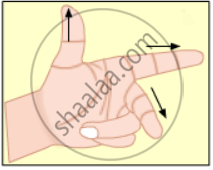
State two ways to increase the speed of rotation of a D.C. motor.
The north pole of Earth’s magnet is in the ____________.
|
The graph (fig A) illustrates the correlation between the number of protons (x-axis) and the number of neutrons (y-axis) for elements A, B, C, D, and E in the periodic table. These elements are denoted by the letters rather than their conventional symbols. When the element C, depicted in the graph, undergoes radioactive decay, it releases radioactive rays. When these rays are directed into the plane of the paper in the presence of a magnetic field, as indicated in the fig B, they experience deflection, causing them to move upwards.
|
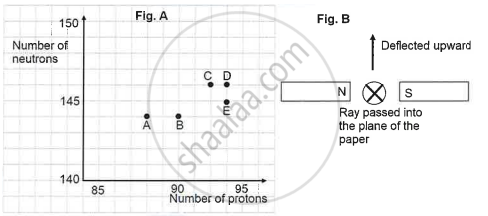
Name the law used to identify the radioactive radiation emitted by the element.
